

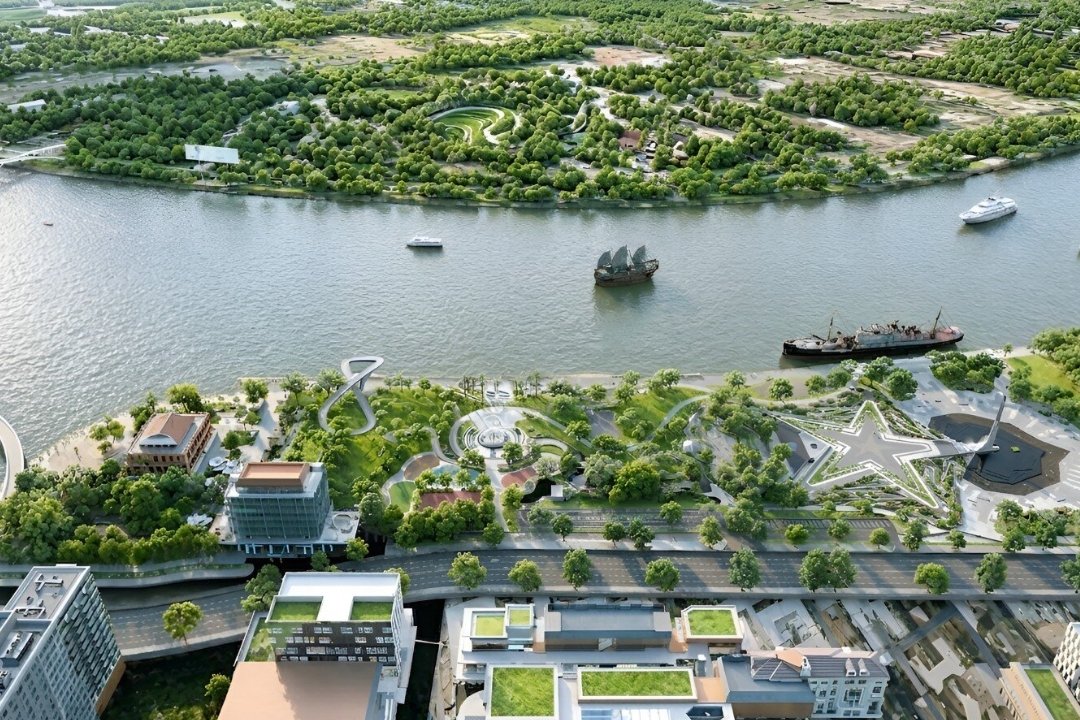
The People’s Committee of Ho Chi Minh City has partnered with Sun Group to start construction on a major 73.3-hectare urban redevelopment scheme along the Saigon River. Valued at 29,317 billion VND, the project was officially commenced during a ceremony on July 1 2026. The milestone forms part of celebrations marking 50 years since the city was renamed from Saigon – Gia Dinh.
Funded through a Public-Private Partnership model using a Build-Transfer contract, the initiative is being delivered by Ben Nha Rong Tourism Services Co., Ltd., a subsidiary of Sun Group. The infrastructure development covers five interconnected projects designed to modernise the southern entrance to the city while restoring local historic sites.
A major feature of the infrastructure plans involves widening Nguyen Tat Thanh Street from four lanes to ten lanes. This expansion aims to ease severe traffic congestion that has affected the southern gateway for years. Transport upgrades also include constructing a new Tan Thuan 1 bridge, widening the Tan Thuan 2 bridge and building the Hoang Dieu underpass alongside modern parking facilities and docks.
On the opposite side of the river, the Bach Dang Wharf area will receive substantial upgrades. Plans include an underground shopping center, subterranean parking lots and enhanced public parklands. A new pedestrian bridge spanning the Saigon River will connect the Bach Dang and Nha Rong – Khanh Hoi wharfs, linking the public spaces together.
The project also focuses heavily on heritage preservation through the development of the Ben Nha Rong Cultural Park. This section integrates with the Ho Minh Museum grounds to mark the historic site where Nguyen Tat Thanh departed Vietnam on June 5 1911. A full-scale authentic reconstruction of the original French vessel, the Amiral Latouche-Tréville, will be brought to the site to replace initial simulated proposals.
The developer is using an adaptive reuse strategy described as an “Old Shell – New Core” approach. This model converts old shipping warehouses into cultural, commercial and exhibition areas, retaining the architectural identity of the original Khanh Hoi trading port while creating new community green spaces.



![[IRHM] logo](https://irhmagazine.com/wp-content/uploads/2025/08/IRHM-AWARDS-2025-1024x683.jpg)