

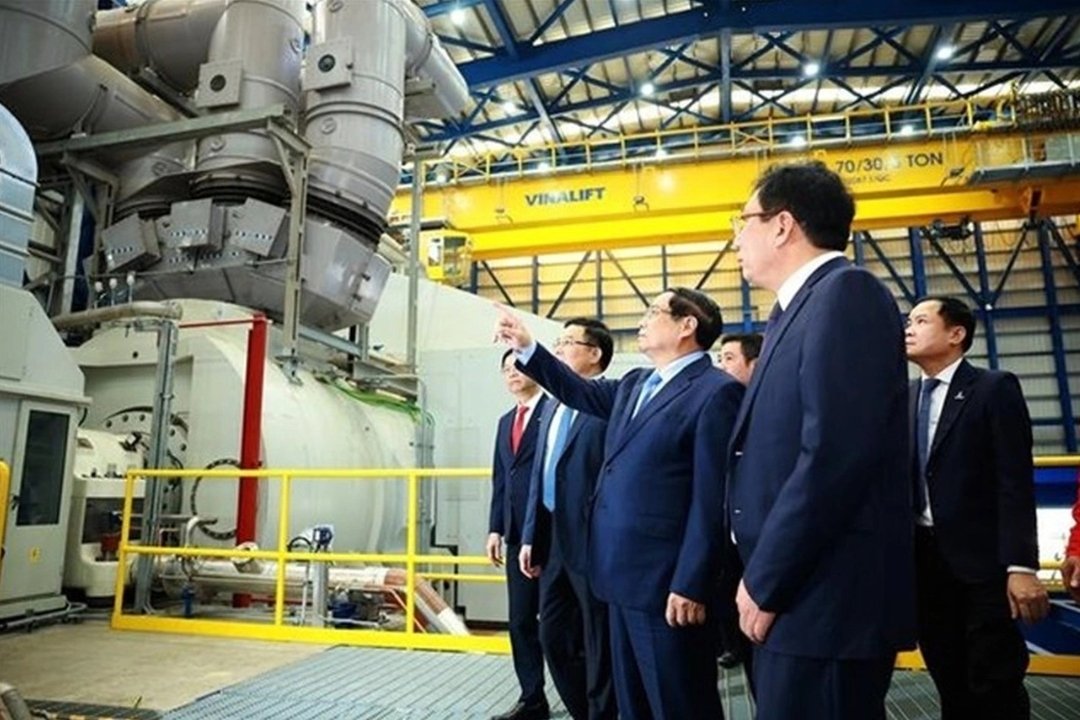

Vietnam has officially inaugurated its first liquefied natural gas (LNG) power complex, the twin Nhon Trach 3 and Nhon Trach 4 facilities. Prime Minister Pham Minh Chinh opened the plants on Sunday, December 14, 2025, marking a strategic shift toward cleaner energy and enhanced national grid stability.
The complex, located in Dong Nai Province, was built by state energy giant Petrovietnam at a total investment cost of USD1.4 billion. The plants are scheduled for commercial operations in early 2026. With a combined capacity of 1,624 megawatts (MW), the facilities are designed to generate more than nine billion kilowatt-hours (kWh) of electricity annually. This substantial baseload power source will support the national grid, particularly in southern Vietnam, the country’s economic engine.
Prime Minister Chinh stressed the project’s critical role in national energy strategy. He described the project as “a particularly important piece” in strengthening national energy security and supporting rapid, sustainable development. Vietnam’s peak electricity demand is currently about 54,500 MW, growing by an estimated 6,500 to 8,200 MW each year. This urgent demand is driven by rapid expansion in sectors such as high-tech manufacturing, semiconductor production, data centres, and major infrastructure projects.
The facilities are equipped with U.S. firm GE’s 9HA.02 gas turbines, described as among the world’s most advanced in capacity and efficiency. This technology is expected to achieve an efficiency of 62 to 64 per cent. In line with Vietnam’s pledge to achieve net-zero emissions by 2050, the LNG-fired generation is a cleaner alternative. It reduces carbon emissions by roughly 40 per cent compared with coal and 30 per cent compared with oil. Furthermore, the turbines can currently co-fire up to 50 per cent hydrogen, with a potential future transition to 100 per cent hydrogen use.
The construction, which began in May 2022, was managed by a consortium of Lilama and Samsung C&T as the EPC contractor. Lilama, a domestic contractor, accounted for about 40 per cent of the EPC work. The contractor selection process took just 11 months, noted as among the fastest for a project of this scale. The project is notable for being the first power facility in Vietnam to successfully secure over $1 billion in international loans without requiring a government guarantee.
The development process faced numerous obstacles, including difficulties in land acquisition, equipment logistics, and an incomplete regulatory framework regarding long-term Power Purchase Agreements (PPAs) and LNG pricing. Petrovietnam chairman Le Manh Hung said the project’s success creates a template for future LNG power centres. The plants are expected to lay the groundwork for developing a gas-fired power market in Vietnam. They will provide a model for 13 additional LNG projects outlined in the national Power Development Plan VIII. To achieve national goals, the Prime Minister urged ministries to finalise policies for the LNG power supply chain, remove procedural bottlenecks, and encourage enterprises to negotiate spot LNG imports to manage price risks.


![[IRHM] logo](https://irhmagazine.com/wp-content/uploads/2025/08/IRHM-AWARDS-2025-1024x683.jpg)