
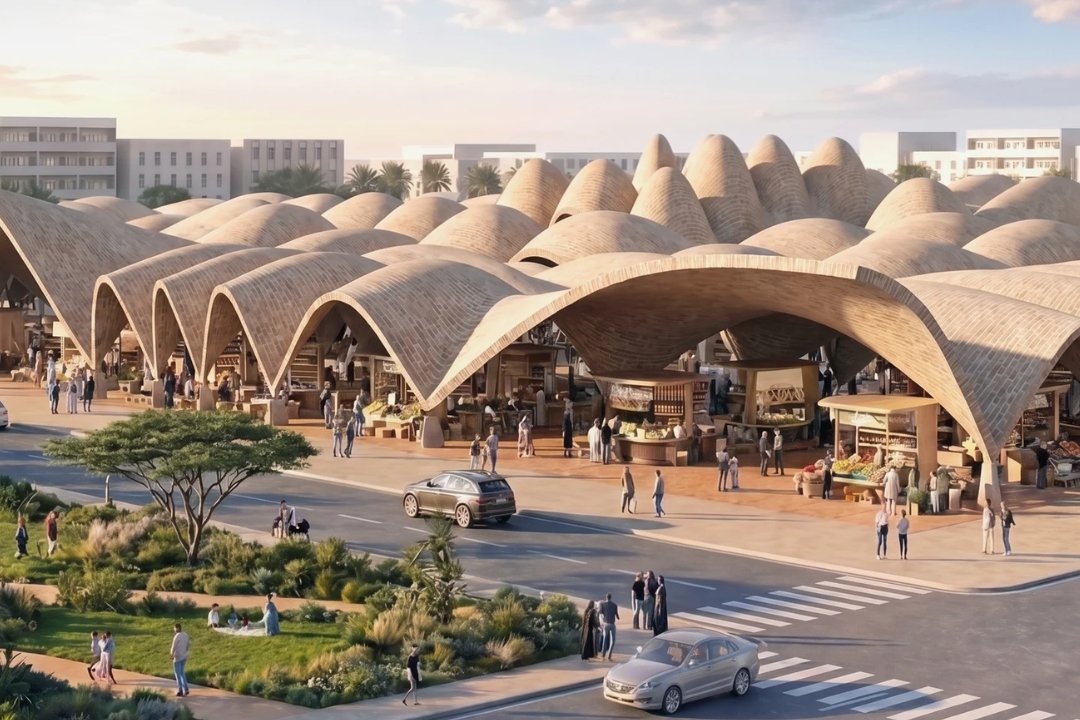

A coalition of international design and engineering firms has presented the Benghazi 2050: Next Generation City Plan, setting out an adaptable spatial framework and a dynamic digital planning platform for the historic Libyan port city.
The proposal was created by a consortium comprising A&O TEC, Prior+Partners, Zaha Hadid Architects (ZHA), Homa, Buro Happold, Systematica and Fichtner. It was officially introduced at the Global Competitive Urban Planning Initiative – Benghazi 2026.
Benghazi is entering a phase of rapid economic growth and physical expansion, driving the demand for a coordinated development framework. The new strategy aims to reconnect residential neighbourhoods and regional centres with the shoreline and historic city centre using public transport and dedicated pedestrian networks.
Rather than relying on demolition or rigid growth boundaries, the plan prioritises urban restoration and connectivity. The framework identifies designated knowledge and employment districts while incorporating natural zones to assist with ecological diversity and sustainable water management across the metropolitan area.
Serving as the technical foundation for the vision, the Digital Planning Hub operates as a shared evidence base and digital twin. The interface aggregates 3D urban models, population data, land-use records, transport networks, geospatial information and environmental metrics. It also tracks active development schemes alongside potential future planning scenarios.
Designed as an evolving tool, the hub provides a collaborative interface for city authorities, design teams, investors and local residents to assess future construction proposals within the broader urban context.




![[IRHM] logo](https://irhmagazine.com/wp-content/uploads/2025/08/IRHM-AWARDS-2025-1024x683.jpg.webp)