

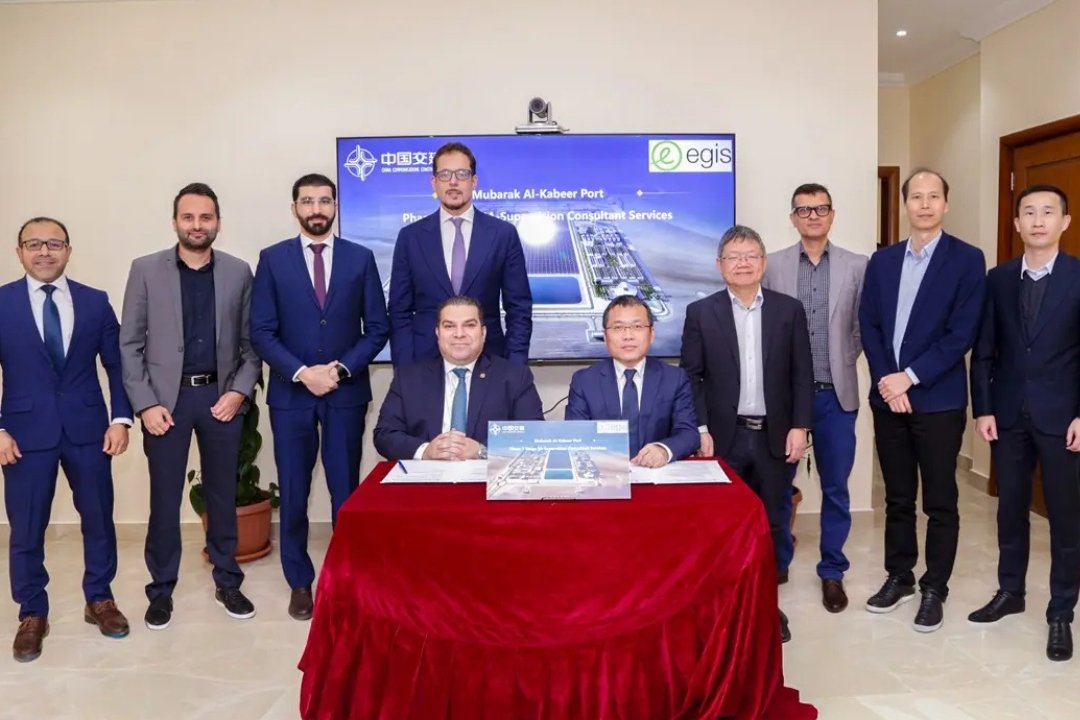
The French engineering group Egis has been selected to manage the final construction and commissioning of Phase 1 at Mubarak Al-Kabeer Port. The appointment marks a critical step for one of the country’s most significant national infrastructure projects, aimed at turning Boubyan Island into a major regional trade hub.
Egis will provide project management and construction supervision to ensure the port reaches full operational readiness. The firm is tasked with overseeing the completion of marine and onshore works, as well as the necessary utilities and buildings. While the physical foundations, including quay structures, were finished back in 2014, the current focus is on bringing the asset into active service for the first time.
The project is being delivered under an Engineering, Procurement and Construction (EPC) contract led by China Communications Construction Company (CCCC). Egis will work alongside both CCCC and the Ministry of Public Works to monitor schedules, costs, and health and safety standards.
A spokesperson for China Communications Construction Company said: “Mubarak Al-Kabeer Port reflects a long-term national vision that requires world-class technical governance. We have integrated Egis into this project to leverage their deep expertise in independent design audit and construction oversight. Their role is vital in ensuring that every element of the remaining works is aligned with the standards, systems, and operational requirements expected of a major international port, in line with Kuwait Vision 2035.”
The port is designed to serve as a primary gateway for the Upper Gulf. Egis will use its regional experience to handle the complex marine structures and channel works required to accommodate international shipping. This oversight will continue from the start of the current mobilisation period through to the final handover.
Khaled ElMir, Country Managing Director for Egis in Kuwait, added: “Mubarak Al-Kabeer Port is critical as it sits at the intersection of Kuwait’s economic ambition and its responsibility to future generations. Our role is to help ensure that when the port opens, it does so with systems, processes, and confidence fully in place.”



![[IRHM] logo](https://irhmagazine.com/wp-content/uploads/2025/08/IRHM-AWARDS-2025-1024x683.jpg)