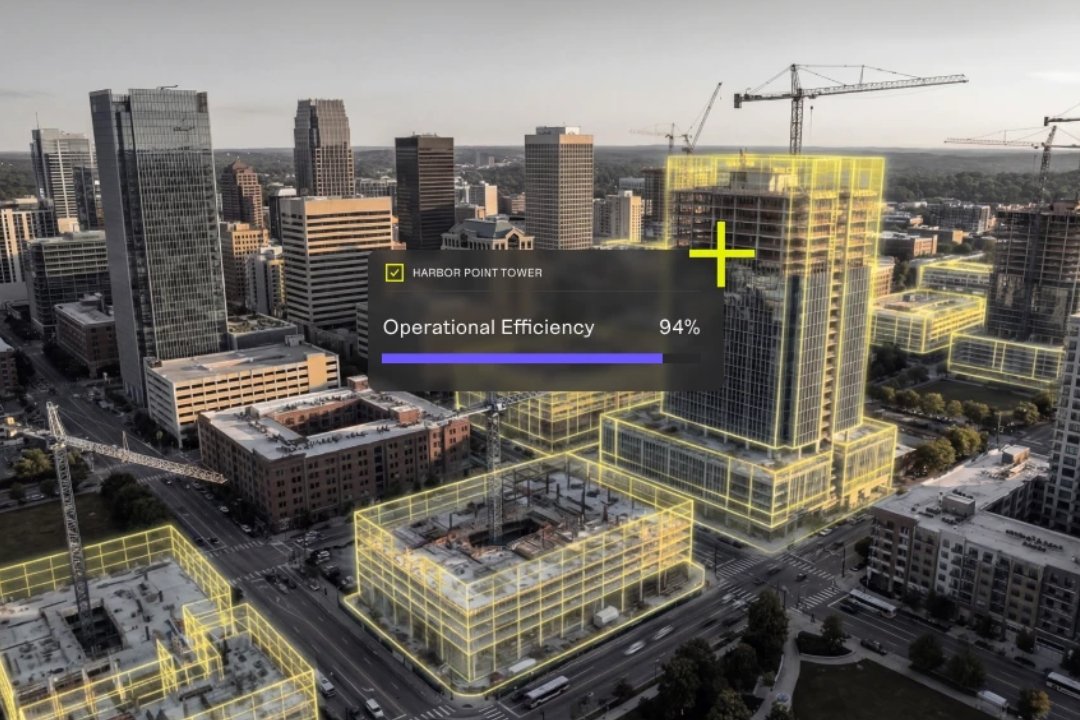





From generative design to algorithmic pricing, artificial intelligence is rewiring the real estate capital stack. As adoption expands across the project lifecycle, developers and investors face a twin imperative: capturing productivity gains while navigating new regulatory boundaries.
Property development has always been a business of slow, expensive guesses. A developer commits capital to land, design and construction years before knowing whether the finished asset will lease, sell or perform the way the underwriting model promised. Artificial intelligence is not eliminating that uncertainty, but across five distinct layers of the development process: site planning and design, data infrastructure, investment underwriting, construction delivery and leasing and asset management, it is now measurably changing how quickly decisions get made and how much information sits behind them. This is not a single technology story. It is five separate, verifiable shifts happening at once, each with its own named companies, funding and adoption data behind it, and, increasingly, its own regulatory scrutiny too. Evaluating each shift requires examining the specific projects, figures and legal proceedings behind it, rather than treating AI in property development as a single undifferentiated trend.
Designing buildings before the first sketch
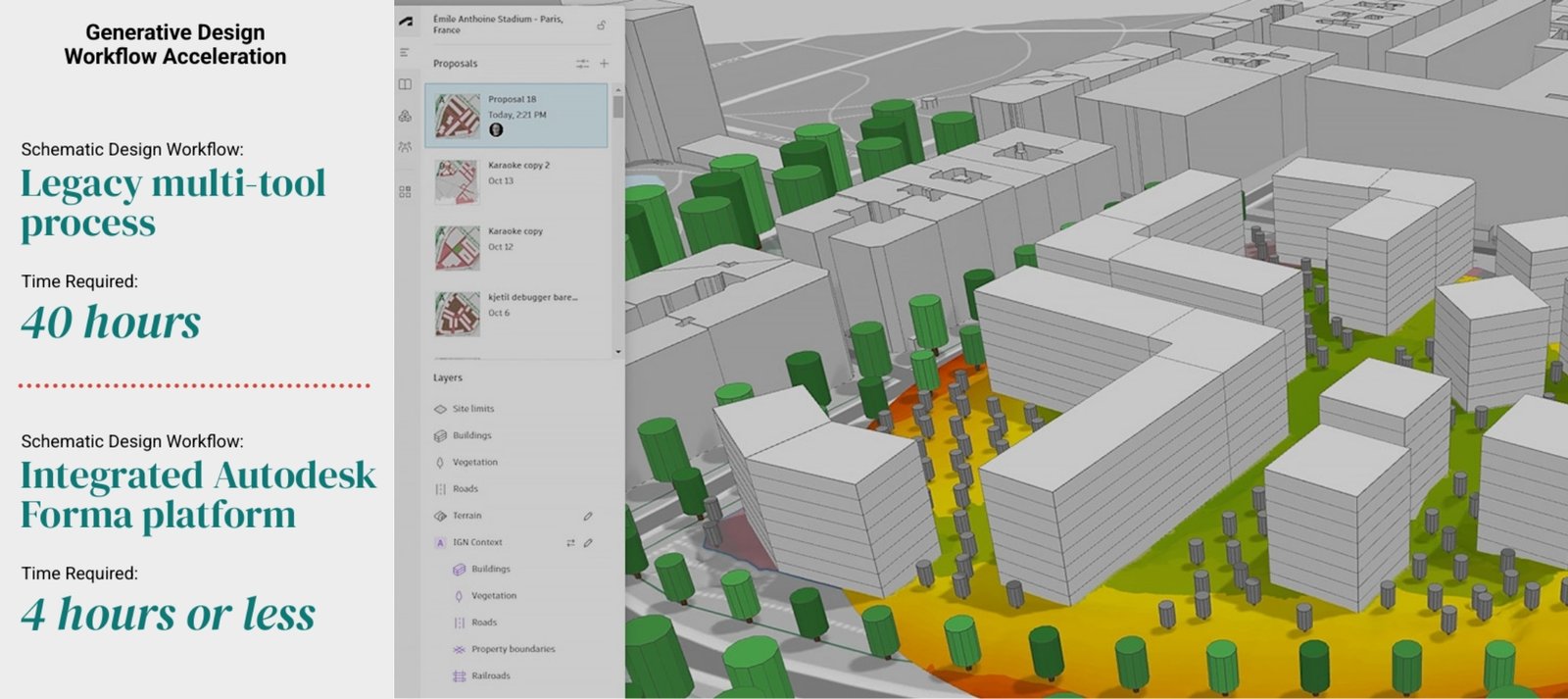
One of the earliest points in the development process where AI is making a measurable impact is site feasibility and massing, the stage where a developer needs to know quickly how many units, how much floor area and how much daylight a given plot can actually support before committing design fees to it. Autodesk’s Forma platform, built on the company’s 2020 acquisition of Norwegian startup Spacemaker, has become a prominent commercial example of this shift moving beyond research and into professional practice. The platform lets architects and developers test parameters such as building footprint, height, density and site constraints, generating and comparing multiple massing options while analysing factors including daylight, sun exposure, wind, noise and embodied carbon. Forma Site Design was named a winner in Architectural Record’s 2025 Best Architectural Products of the Year competition, with the jury citing its role in reshaping early-stage design through cloud-based collaboration and integrated workflows.
Autodesk has since pushed the technology further with neural CAD, a new category of AI foundation models designed to reason about and generate precise 2D and 3D CAD geometry, including architectural systems. Autodesk says the models are trained using real-world CAD objects and are designed to support applications across architecture, engineering, manufacturing and other professional design workflows. Its Forma Building Layout Explorer uses neural CAD to generate and analyse building layout options based on constraints and goals, allowing users to compare designs, retain preferred elements and regenerate alternatives. Professional judgement remains essential, with designers still needing to verify AI-generated outputs against applicable planning, zoning and building requirements, including jurisdiction-specific rules around setbacks and shadow impacts. Competing tools have emerged around the same broader workflow, including TestFit for rapid development feasibility and site planning, and Finch 3D and Maket for AI-assisted spatial and floor-plan design.
Two documented projects show what this looks like in practice rather than in a vendor demo. Engineering firm Stantec used Forma’s built-in embodied-carbon analysis on a large-scale, transit-oriented development in Vancouver spanning more than 20 proposed towers of residential, commercial, retail and hotel space. The tool allowed the team to run embodied-carbon calculations in roughly five to ten seconds, compared with traditional life-cycle assessments that can involve third-party software and take days or weeks because of their complexity and specialist requirements. This allowed architects and sustainability consultants to iterate on massing and building heights together in real time, rather than passing the design back and forth between disciplines, according to Stantec Sustainability Consultant Jay Burtwistle, who presented the project at Autodesk University 2024. Separately, Baker Barrios Architects reported in an official Autodesk case study that work which previously required 40 hours using traditional methods now takes four hours or less using Forma, cutting the time required by 90 per cent.
Underwriting deals with machine learning instead of spreadsheets
Once a site or asset has been identified, the traditional next step is underwriting, the labour-intensive process of researching comparable sales, projecting rents and modelling returns before a developer or investor commits capital. Skyline AI, founded in Tel Aviv in 2017 by four serial technology entrepreneurs, Guy Zipori, Amir Leitersdorf, Iri Amirav and Or Hiltch, built its business around compressing this process using machine learning trained on property data drawn from more than 300 separate sources, spanning owner information, property characteristics, demographics, historical transactions and debt. JLL’s venture fund, JLL Spark, had been an investor in the company since 2018 before JLL acquired it in August 2021, by which point Skyline AI’s platform was tracking 400,000 US multifamily properties and evaluating up to 10,000 attributes per asset. Its proprietary models were designed to identify data discrepancies and help investors assess future property values, evaluate acquisition targets and make decisions about when to adjust rents, renovate or sell. JLL subsequently integrated Skyline AI’s technology and proprietary data into its advisory products, giving clients machine-generated insights alongside the judgement of JLL’s real estate advisers. JLL’s Global Capital Markets chief, Richard Bloxam, described the combination as producing insights “beyond human” by bringing together expert advisers and AI-based data analysis. The transaction marked JLL’s first acquisition in Israel, leading to the establishment of a dedicated Tel Aviv research and development centre built on Skyline’s technology.
Data infrastructure becomes the layer everything else depends on
A quieter but arguably more consequential shift has been happening one step behind the underwriting and leasing tools that get most of the attention: the consolidation of real estate’s famously fragmented data into single, AI-ready platforms that other tools and human analysts alike can query. Cherre, founded in New York in 2016 by L.D. Salmanson and Ben Hizak, built exactly this kind of infrastructure: a universal data model and knowledge graph designed to unify disparate public, proprietary and customer data into a single, trusted foundation. By mid-2026, the company had raised 105 million US dollars across four disclosed funding rounds, including a 50 million US dollar Series B in 2021 led by Trustbridge Partners, and said its platform powered the management of 3.3 trillion US dollars in global assets under management. On 14 July 2026, RealPage, a leading provider of AI-enabled software and data analytics to the real estate industry, completed its acquisition of Cherre, describing the deal as connecting property-level operations with portfolio and fund-level intelligence across what RealPage called the entire real estate capital stack.
That acquisition is worth pausing on, because RealPage is not a neutral example. The same company now absorbing one of real estate’s leading data platforms had, seven months earlier, agreed to a landmark antitrust settlement over a different AI-driven product, a detail with significant regulatory implications examined below, and the juxtaposition says something real about how fast this industry’s relationship with AI-driven data is moving on two fronts simultaneously: expanding capability and expanding scrutiny.
Construction planning learns to simulate before it builds
The construction phase has its own distinct set of AI tools, separate from the physical robots increasingly appearing on job sites, focused instead on planning, estimating and scheduling before or alongside actual building work. Togal.AI is an AI tool focused specifically on quantity takeoff, the process of measuring and counting materials, spaces and other elements from architectural drawings to price a project. The company reports up to 98 per cent accuracy on floor plan takeoffs. A 2025 University of Kansas study comparing Togal.AI with On-Screen Takeoff found roughly 71 per cent average time savings across its two main case studies, while Togal cites savings of up to 76 per cent. The study also found that human review and adjustment remained important, particularly where drawings were lower quality or contained complex annotations. The commercial impact for firms using it is not hypothetical. Coastal Construction, a Florida-based general contractor, estimated that Togal.AI contributed to $3.2 million in savings during 2025, although the company also noted that internal process improvements and changes in project mix contributed to the overall reduction in preconstruction costs.
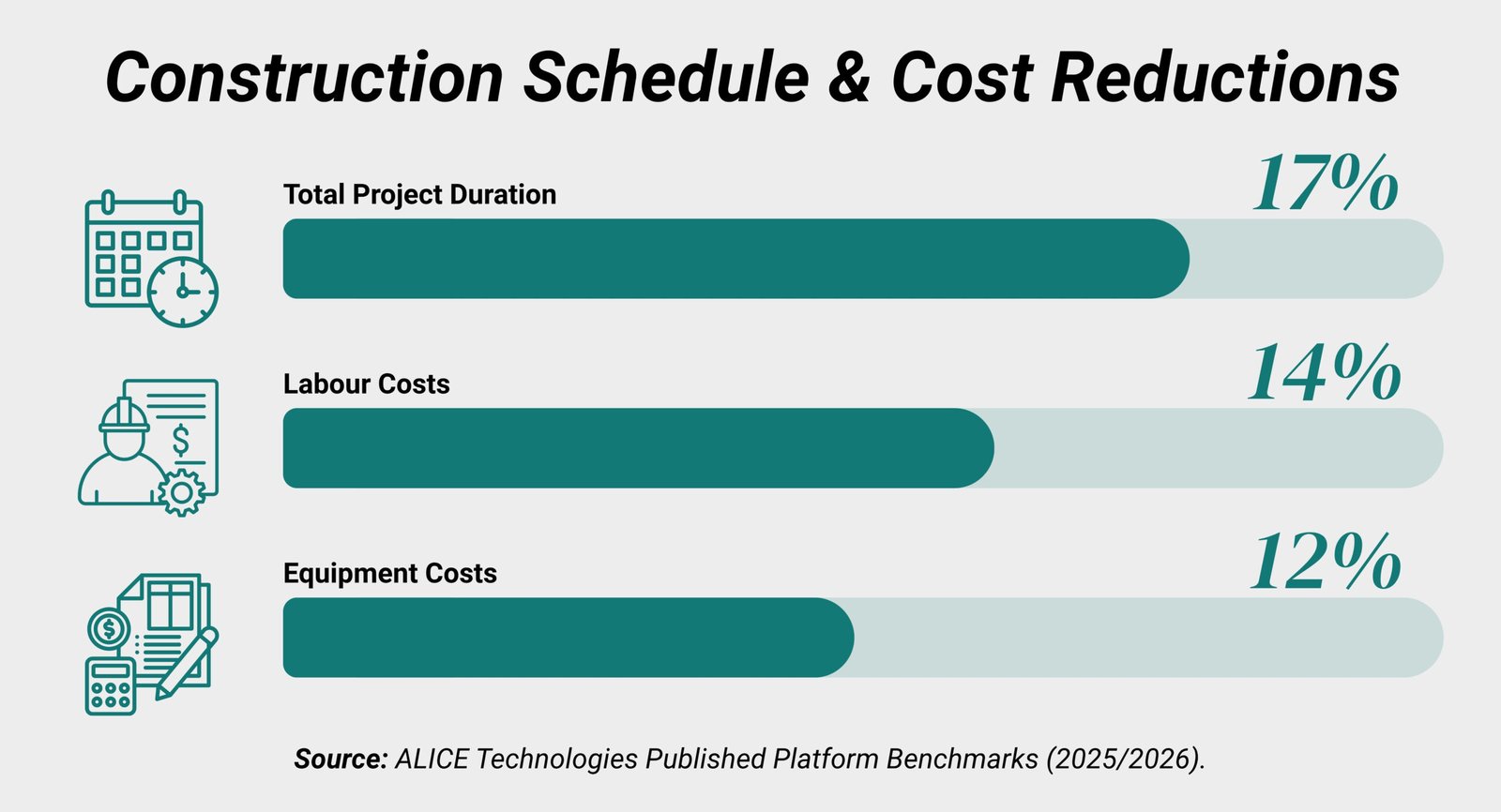
Scheduling has followed a similar path, and the results are documented at named-project level rather than only in aggregate. ALICE Technologies, whose platform evaluates millions of possible construction sequences to identify more efficient paths to completion, formalised an alliance with McKinsey in April 2026 to deploy AI- and advanced-analytics-enabled generative scheduling on large capital projects. In one McKinsey-documented case, a leading global data-centre provider used the platform to simplify schedule logic and optimise sequencing and resource allocation, uncovering more than 13 optimisation opportunities and ultimately cutting the baseline construction schedule by around 40 per cent. In a separate case, a general contractor engaged ALICE on an eight-mile interstate highway widening and bridge reconstruction project in the eastern United States after work was already underway, specifically to recover time lost to earlier delays. ALICE reports that the resulting optimisation generated more than $25 million in savings. ALICE’s own published platform benchmarks indicate a 17 per cent reduction in total project duration, 14 per cent labour cost savings and 12 per cent equipment cost savings, though these are the company’s own aggregate figures rather than independently audited results, a distinction worth keeping in mind when reading any vendor’s performance claims.
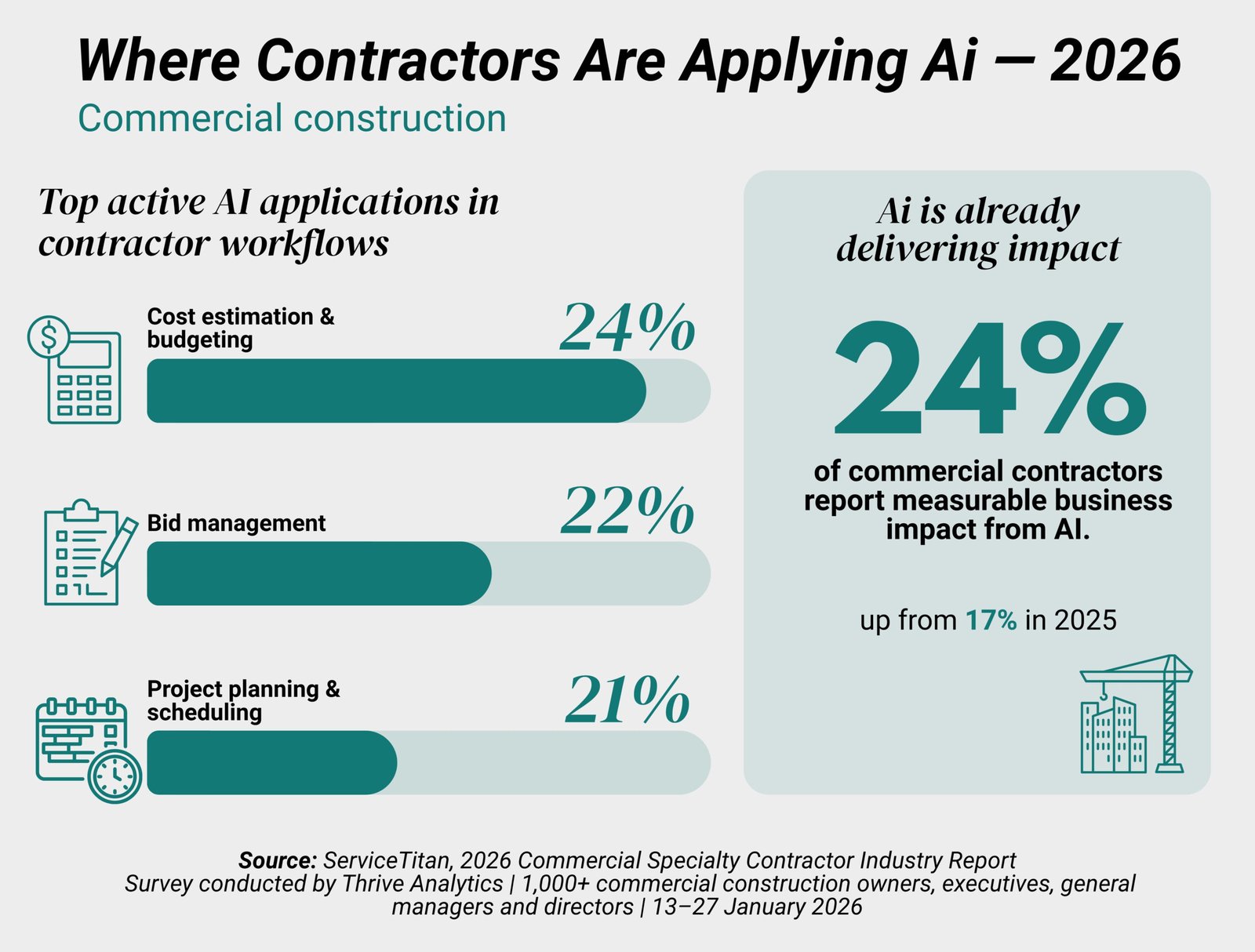
Industry-wide adoption of AI in construction remains uneven rather than universal. ServiceTitan’s 2026 survey found that cost estimation and budgeting was the most commonly reported AI use case among the contractors surveyed, cited by 24 per cent, followed by bid management at 22 per cent and project planning and scheduling at 21 per cent. Overall, 38 per cent of respondents said AI was already having a measurable impact on their business, up from 17 per cent in 2025.
Leasing and asset management get an always-on front desk
The final layer where AI has achieved demonstrable operational scale sits at the operating end of the development lifecycle: leasing, resident communication and property management, once a building is complete and occupied. EliseAI, founded in New York in 2017 by Minna Song and Tony Stoyanov after Song experienced the repetitive communication demands of working at a New York residential real estate firm, has become one of the clearest examples of AI adoption at operational scale in real estate. The company’s AI assistants communicate with prospective and current tenants across text, email, phone and voice, book apartment tours, process applications and triage maintenance requests around the clock. By June 2026, EliseAI said one in six apartments in the US was running on its platform, while the company had partnered with 70 per cent of the 50 largest multifamily owners and operators in the country.
The company’s growth trajectory illustrates how quickly investor confidence in this specific application of AI has built. EliseAI raised a 250 million US dollar Series E round in August 2025 at a 2.2 billion US dollar valuation, led by Andreessen Horowitz with participation from Bessemer Venture Partners and Sapphire Ventures, having surpassed 100 million US dollars in annual recurring revenue earlier that year. Since its Series D round, the company had also grown from 150 to more than 300 full-time employees. By June 2026, EliseAI had announced 200 million US dollars in annual recurring revenue, representing 100 per cent year-on-year growth for the fifth consecutive year. By August 2026, the company was reportedly in talks to raise a further 300 million US dollars at a valuation of 3.7 billion US dollars. If completed at those terms, that would represent a potential 1.5 billion US dollar increase in valuation in twelve months. The wider property management software market was valued at around 6.53 billion US dollars globally in 2026 and is projected to reach 9.93 billion US dollars by 2031, according to Mordor Intelligence. EliseAI has also extended the same conversational automation model beyond housing into healthcare, where it began developing front-desk and scheduling applications in 2023, demonstrating the broader applicability of the technology beyond its original real estate use case.

When the algorithm draws regulatory scrutiny
No treatment of AI in property development is complete without one of the clearest cautionary examples the industry has produced to date, and it involves RealPage, the same company behind the Cherre acquisition described above. RealPage’s revenue management software uses algorithms to generate rental pricing recommendations for landlords managing multifamily housing, and the US Department of Justice sued the company alleging that its software used non-public, competitively sensitive data shared by competing landlords to coordinate pricing in violation of Sections 1 and 2 of the Sherman Act, which the DOJ alleged had the effect of replacing independent pricing decisions with algorithmic coordination. On 24 November 2025, the DOJ announced a proposed settlement under which RealPage did not admit wrongdoing or pay damages but agreed to significant restrictions on how its pricing software could use and present data. Among other measures, RealPage must use rental data that is at least 12 months old, cannot report rental pricing information more narrowly than at the statewide level, must remove or redesign features that limited price decreases or aligned pricing between competitors and must accept a court-appointed monitor. RealPage’s president and chief executive, Dirk Wakeham, called the resolution “an important milestone” that brings “clarity and stability” for the company and its customers.
RealPage’s legal exposure did not end with the DOJ settlement. Several of the company’s landlord customers, including Greystar, the largest landlord in the United States, Willow Bridge, Cushman & Wakefield and LivCor, were named alongside RealPage as defendants in the federal case, together with Camden Property Trust, Pinnacle Property Management Services and Cortland. Greystar separately reached a proposed settlement with the DOJ in August 2025 that prohibited it from using revenue-management products that rely on third-party non-public data to recommend or set prices, among other restrictions. In a parallel multidistrict class action brought by renters, a federal judge in Tennessee has preliminarily approved 37 proposed settlement agreements with a combined value of $359.9 million, covering claims involving numerous property owners and managers; the settlements remain subject to final court approval. New York has gone further than federal enforcement alone, amending its state antitrust law, the Donnelly Act, effective 15 December 2025, to prohibit certain algorithmic rent-setting practices and extend the law to software providers whose systems perform a statutory “coordinating function” among residential rental property owners or managers. RealPage has responded by suing New York’s Attorney General, arguing that the new law violates the First Amendment by restricting what it characterises as protected speech. The case remained pending as of September 2026.
The RealPage case matters beyond rental pricing because it illustrates a broader regulatory question facing AI-driven real estate tools: where does legitimate data analysis end and algorithmic coordination begin? The DOJ’s settlement focuses particularly on the use of current, non-public, competitively sensitive information and on mechanisms through which pricing recommendations can align decisions between competing landlords. That distinction is directly relevant to the underwriting, data infrastructure and leasing tools described earlier, many of which depend on pooling information from multiple properties and owners. For developers and operators adopting AI systems that touch pricing or other competitively sensitive information, the practical lesson is not that AI itself is legally suspect, but that the source of the data, how current it is, who contributes it, how it is combined and how the resulting recommendation is used can all become matters of regulatory scrutiny.

What adoption actually looks like, and where it does not
It would be inaccurate to describe AI as having swept uniformly across property development, as individual success stories can easily create a false impression of universal adoption. The ServiceTitan figures cited earlier provide a useful corrective: while 38 per cent of commercial contractors surveyed in 2026 said AI was already having a measurable impact on their business, individual use cases remained much less widespread, with cost estimation and budgeting cited by 24 per cent and bid management by 22 per cent. Independent evidence on outcomes such as safety improvement remains thinner than the volume of vendor-reported case studies, and developers evaluating these tools should weigh vendor claims accordingly rather than treating them as independently audited fact.
What is not in dispute is the underlying economic problem driving continued investment, regardless of where any individual firm sits on the adoption curve. Autodesk and construction research firm FMI estimated that bad data cost the global construction industry 1.85 trillion US dollars in 2020, with decisions made using bad data accounting for an estimated 88.69 billion US dollars in rework, or 14 per cent of all rework performed that year. The study surveyed more than 3,900 construction professionals globally and defined bad data as information that was inaccurate, incomplete, inaccessible, inconsistent or untimely. That provides a clearer explanation for the appeal of AI applications built around data capture, document analysis, estimating and takeoff accuracy: the opportunity is not simply to introduce a more sophisticated tool, but to reduce the cost of decisions made from information that is incomplete, inconsistent or slow to verify. Each of the five categories covered here, spanning generative design, underwriting, data infrastructure, construction planning and leasing operations, addresses a version of that same problem: too much time and capital lost to manual processes working from incomplete or slow-to-verify information. The RealPage case adds a sixth consideration that sits alongside all of them: even genuinely useful AI tools built to solve real inefficiency can cross a legal line if the data feeding them is handled improperly, and that risk is now demonstrably real rather than theoretical.
Compressing the guesswork
None of the tools covered here replace the fundamental judgement calls that define a successful development: where to build, what to build and when to sell or hold. What they do is compress the time and cost of reaching each of those decisions and, increasingly, provide a quantitative second opinion that a human team can accept, challenge or override, with access to more information than was available even five years ago. The developers, investors and operators moving fastest are not necessarily the ones spending the most on AI. They are the ones that have identified which specific, repetitive, data-heavy bottleneck in their own process, whether in feasibility studies, underwriting research, portfolio data management, cost estimating or tenant communication, is costing them the most time relative to the value it adds, and matched it to a tool built specifically to remove that bottleneck rather than adopting AI as a general strategy.
At the same time, the RealPage settlement is a genuine inflection point that developers and operators should not treat as a footnote specific to one company. It demonstrates the regulatory scrutiny that can arise when AI systems use competitively sensitive, nonpublic information across competing businesses to influence pricing decisions. The distinction is particularly relevant to the platforms covered here, from Skyline AI’s underwriting models to Cherre’s unified data layer to EliseAI’s leasing assistants, because each depends on data spanning multiple properties and, in some cases, multiple owners. That breadth of data is precisely what makes these systems powerful, and precisely why the industry’s use of AI is likely to face more scrutiny, not less, as adoption grows. Property development has never been a fast industry, and artificial intelligence is not about to make land assembly, permitting or construction financing move any faster. What it is doing, verifiably and at real commercial scale, is making the thinking that happens in between those slow, expensive steps considerably quicker and better informed, provided the data underpinning that thinking is used within the boundaries regulators are now actively drawing.



![[IRHM] logo](https://irhmagazine.com/wp-content/uploads/2025/08/IRHM-AWARDS-2025-1024x683.jpg)