


Construction robotics has spent years living mostly in trade show demos and funding announcements. That is starting to change. A small but growing number of robots, autonomous excavators, bricklaying machines, layout printers and inspection systems are now working on active job sites rather than test rigs. The reason is not novelty. It is persistent labour shortages and a safety record the industry has struggled to improve through conventional methods.
 The problem robots are being built to solve
 The problem robots are being built to solve
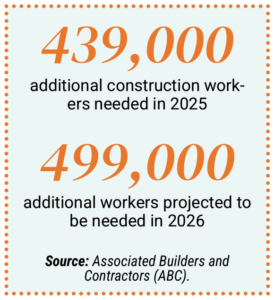
The scale of the shortage is well documented. Associated Builders and Contractors (ABC) estimated that the industry would need an additional 439,000 workers in 2025, rising to roughly 499,000 in 2026, to meet projected demand. Roughly a quarter of the construction workforce is foreign-born, a notably higher share than the labour force overall, making the sector unusually exposed to immigration policy shifts. The Associated General Contractors of America (AGC) 2025 workforce survey found that immigration enforcement had directly or indirectly affected 28 per cent of construction firms. The same survey found that staffing gaps were causing project delays for 45 per cent of firms. The figures illustrate the operational pressure created when contractors cannot fill available positions.
That safety picture is stark on its own terms. US Bureau of Labor Statistics data shows that construction recorded 1,034 fatal workplace injuries in 2024, down from 1,075 in 2023, a decline of nearly 4 per cent, but still the highest raw number of fatalities among individual private industries. Falls remain one of the industry’s leading causes of workplace deaths, while struck-by incidents, caught-in or caught-between incidents and electrocutions are also among the principal hazards identified by OSHA. The main categories of robot now appearing on job sites map onto these pressures in different ways: helping contractors address roles they struggle to staff, improving productivity and precision, or reducing the need for workers to perform some of the tasks that carry the greatest risks.
Heavy equipment learns to drive itself
The clearest example of scale deployment is in earthmoving. Bedrock Robotics, founded by alumni of Waymo’s autonomous trucking programme, retrofits excavators ranging from 20 to 80 tons with AI controllers for supervised autonomous mass excavation. In November 2025, the company completed a large supervised autonomy deployment, moving more than 70,000 cubic yards of soil alongside Sundt Construction on a 130-acre manufacturing site. Bedrock says its systems are now installed across excavators in the 20 to 80-ton range and are being used by a growing network of construction partners.
Built Robotics takes a different route with its Exosystem, an aftermarket upgrade that installs on modern excavators from leading manufacturers in less than a day. The system uses RTK GPS, inertial measurement units, cameras and other sensors to enable autonomous trenching while allowing the excavator to retain manual operation. Built says the system is compatible with 15 to 50-ton machines and can operate for additional shifts without an operator in the cab.
Caterpillar is taking a broader OEM approach. At CES 2026, the company introduced a new portfolio of autonomous construction machines covering excavators, loaders, haul trucks, dozers and soil compactors, building on roughly four decades of autonomy development that began in the mid-1980s and was initially focused heavily on mining. Caterpillar says it has more than 30 years of real-world autonomous machine deployment experience, including commercial autonomous hauling in mining since 2013
 Bricklaying, finishing and layout work
 Bricklaying, finishing and layout work
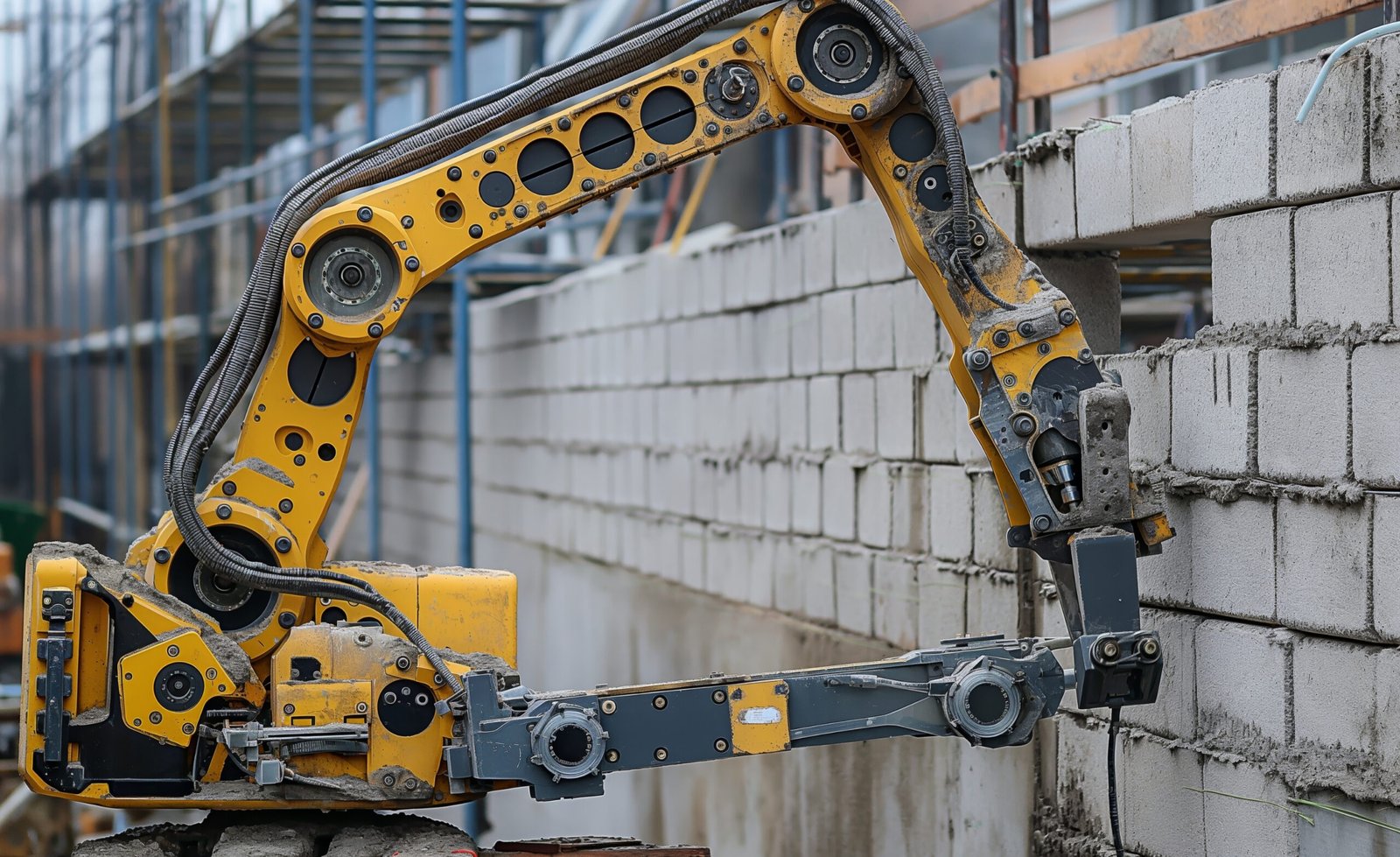
Away from heavy equipment, robots are taking on repetitive trade work with the same logic. Monumental, a Dutch company, has developed Atrium, its operating system for on-site construction, which converts architectural drawings into robot-executable plans, coordinates fleets of autonomous robots and provides real-time quality control. The company says its robots are now working on real construction sites across the Netherlands and the UK, having built walls for more than 100 homes as well as a school, community centre, hotel and canal infrastructure. Construction Robotics’ SAM100 takes a semi-automated approach in the United States, working alongside a human mason rather than replacing the trade outright. Okibo’s EG7, a fully autonomous painting and drywall finishing robot, uses AI-guided 3D scanning and real-time modelling, requires no site preparation or external equipment and can finish an average of 1,000 square feet per hour. The company says its robots have covered more than one million square feet across Europe.
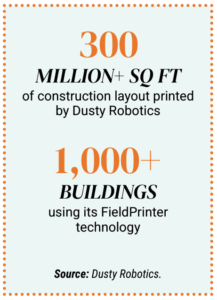
Layout has become another practical entry point for construction robotics because it involves a clearly defined, repetitive task that can be linked directly to digital building models. Dusty Robotics’ FieldPrinter takes coordinated building information modelling data and prints multi-trade layout marks directly onto the slab. The company says its robots have now printed more than 300 million square feet of construction layout across more than 1,000 buildings, with the system being used across sectors including data centres, healthcare, industrial, multifamily residential, hospitality and commercial construction.
The Limits of Automation
It is worth being direct about the limits of current adoption. Construction robotics remains focused on individual tasks rather than fully automated job sites, with machines typically operating under human supervision and within defined parameters. Fully autonomous sites capable of coordinating the complete construction process remain a distant prospect, while humanoid robots face a particular challenge in the unpredictable conditions of real construction environments. For now, specialised machines designed for specific tasks are better suited to the job site than general-purpose robots. The distinction matters: the construction robotics market is not moving towards a single machine capable of building a project from start to finish, but towards a collection of specialised systems that automate individual stages of the process.
The New Construction Workforce
For developers, contractors and real estate investors, the case for construction robotics is not simply about replacing labour. It is about addressing persistent staffing shortages while improving productivity, consistency and safety on tasks that are repetitive, physically demanding or hazardous. The economic case also extends beyond wages. A machine that can excavate for additional shifts, print layout marks directly from a digital building model or finish drywall without requiring a worker to spend hours on a ladder can affect labour requirements, programme duration and exposure to rework.
The technology is therefore unlikely to produce a job site without people. Instead, the more immediate shift is towards a construction workforce in which people supervise machines, manage exceptions and perform the work that remains difficult to automate, while specialised robots take on increasingly defined tasks. For the industry, that may be the more important transformation: not the replacement of the construction worker, but a gradual change in what the construction worker does.
“The more immediate shift is towards a construction workforce in which people supervise machines, manage exceptions and perform the work that remains difficult to automate.”