


Architecture becomes the draw, while surrounding real estate and hospitality investment is positioned to capture the demand it generates
For much of tourism history, architecture was a backdrop, a handsome facade or a well-preserved skyline framing whatever people actually travelled to see. In some destinations, that relationship has inverted. Increasingly, the building itself is the destination, with visitor numbers showing how effectively distinctive architecture can become a tourism draw in its own right.
New landmarks are pulling in millions of visitors
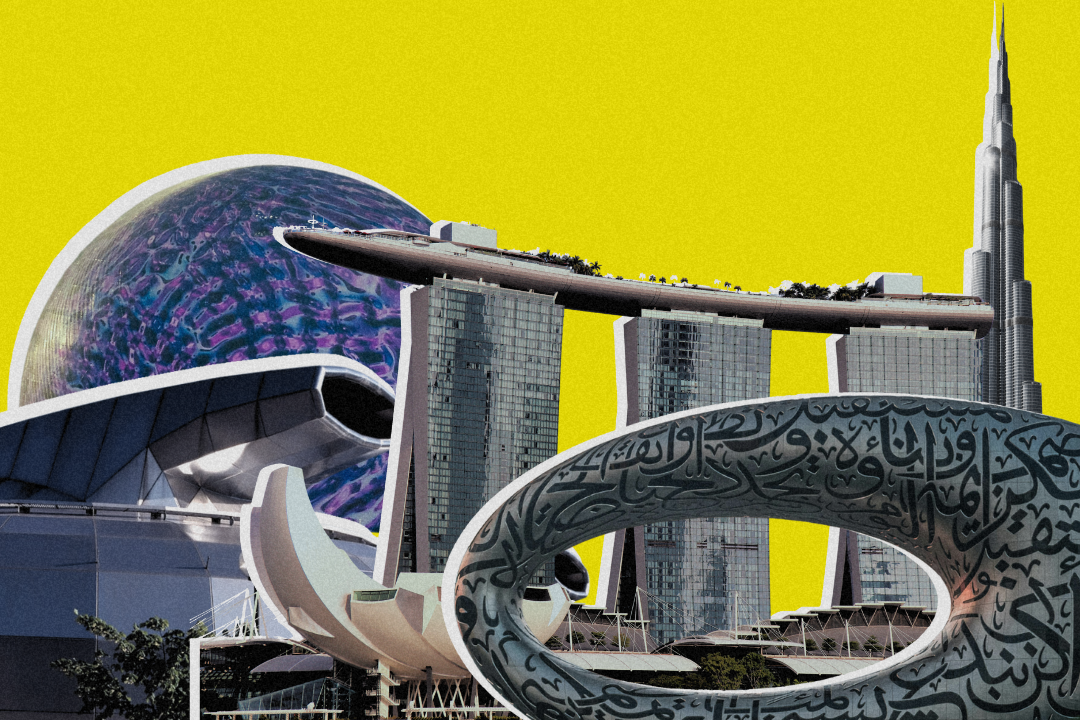
Dubai’s Museum of the Future, a 77-metre torus-shaped structure that opened on 22 February 2022, approached five million visitors by its fourth anniversary in February 2026, while attracting visitors from around the world and hosting nine heads of state and 46 ministers in 2025 alone. The building received LEED Platinum certification in 2023, and its distinctive form, wrapped in Arabic calligraphy featuring quotations from Sheikh Mohammed bin Rashid Al Maktoum, has made it one of Dubai’s defining architectural landmarks.
Singapore’s Marina Bay Sands takes the same principle to an even larger scale. Designed by Moshe Safdie, its three 57-storey hotel towers are topped by a 1.2-hectare SkyPark that sits 200 metres above the ground. The integrated resort opened in 2010 and celebrated its 500 millionth visitor in March 2025, while its operator reported more than 38 million visitors across the property in 2024. Its architecture has become inseparable from Singapore’s modern visual identity, while the resort itself combines hotels, retail, dining, entertainment, conventions and attractions into a single tourism destination.
The Bilbao effect, thirty years on
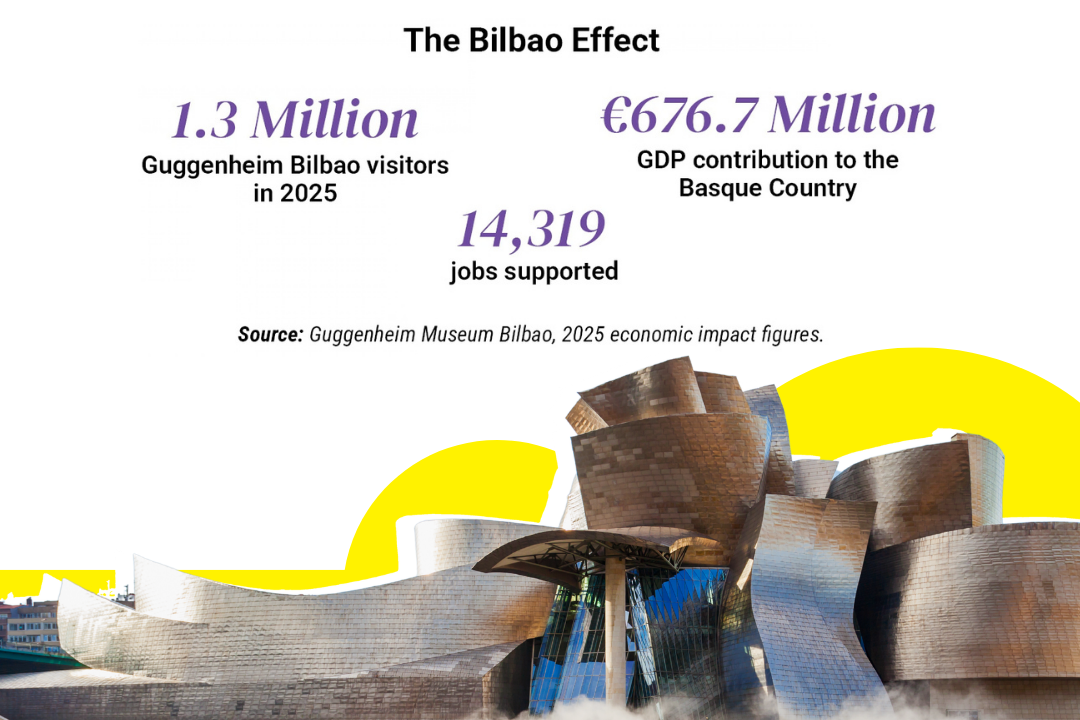
The founding case study behind this phenomenon is still one of the strongest. When Frank Gehry’s Guggenheim Museum Bilbao opened in 1997, the city was a declining industrial centre facing high unemployment, and the museum formed part of a much wider urban regeneration programme that included a new metro system, airport, waterfront redevelopment and other infrastructure. The initial investment of around US$183.8 million was recovered within six years through the economic impact generated by the museum, according to figures subsequently reported from the museum’s 2004 economic impact assessment. Nearly thirty years on, the effect has not faded. In 2025, the museum welcomed 1,305,003 visitors, generated €676.7 million in GDP contribution for the Basque Country, produced €106.1 million in additional public treasury income and supported 14,319 jobs, according to the museum’s latest economic impact figures.
What made Bilbao work is worth being precise about, because the same formula has not transferred everywhere it has been tried. A KPMG visitor survey conducted in 1998 found that almost 84 per cent of respondents identified the Guggenheim as their principal destination, demonstrating the extent to which the museum itself had become a reason to visit Bilbao rather than simply another attraction within the city. The museum was therefore not operating in isolation: its impact formed part of a broader regeneration strategy that combined architecture, cultural programming, transport infrastructure and redevelopment of the surrounding waterfront. Sheffield’s National Centre for Popular Music offers the counterexample. Opened in 1999 with an annual target of 400,000 visitors, it attracted only 104,000 in its first six months and became technically insolvent seven months after opening. It subsequently closed as a visitor attraction in 2000, illustrating that striking architecture and ambitious visitor forecasts are not enough without a viable proposition, realistic market assessment and the wider ecosystem needed to sustain demand.
The data behind the boom
The scale of the phenomenon is visible at both building and destination level. Dubai recorded 18.72 million international overnight visitors in 2024, a 9 per cent increase on the previous year, according to the Dubai Department of Economy and Tourism. The emirate’s tourism strategy has increasingly combined major attractions, distinctive architecture, hospitality and infrastructure as part of a broader destination proposition.
Singapore offers another measure of the scale that a landmark integrated resort can achieve. Marina Bay Sands recorded more than 38 million visits across the property in 2024 and welcomed its 500 millionth visitor in March 2025. The figures cover a destination combining hotels, retail, dining, entertainment, conventions and attractions, illustrating how landmark architecture can operate as part of a much broader hospitality and commercial ecosystem rather than as a standalone visitor attraction.
Bilbao provides the clearest long-term economic evidence. In 2025, the Guggenheim Museum Bilbao welcomed 1,305,003 visitors and generated €676.7 million in GDP contribution for the Basque Country, alongside €106.1 million in additional public treasury income and the maintenance of 14,319 jobs. The figures demonstrate that the economic effect of a landmark cultural building can extend far beyond ticket sales, although the museum’s impact sits within the wider regeneration of Bilbao and the Basque Country rather than existing independently of it.
The Next Generation of Landmark Assets
The next generation of landmark assets is already taking shape across several continents. On Yas Island in Abu Dhabi, Sphere Entertainment and the Department of Culture and Tourism Abu Dhabi are developing Sphere Abu Dhabi, a 20,000-capacity spherical venue with a US$1.7 billion construction contract awarded to ALEC Engineering in May 2026 and completion targeted for the end of 2029. Its predecessor in Las Vegas offers an indication of the commercial demand this type of venue can generate: Sphere sold more than 1.3 million concert tickets in 2024 alone, generating US$420.5 million in its highest annual gross recorded by Billboard Boxscore for any venue. Its opening U2 residency alone drew 662,532 attendees across 40 shows.
A short distance away on Saadiyat Island, the Guggenheim Abu Dhabi is scheduled to open on 11 December 2026, two decades after the project was first announced. Designed by Frank Gehry, the museum has a total built area of approximately 80,000 square metres, or 861,000 square feet, including around 11,600 square metres of interior gallery space. Its ten sculptural cones rise up to 88 metres around a central atrium, making it the largest Guggenheim museum in the world. With development costs reported at around US$1 billion, it represents another attempt to use a globally recognised architectural institution as a catalyst for the wider cultural and real estate ambitions of Abu Dhabi.
Further east, China is building its own version of the same strategy. The Róng Museum of Art, designed by Büro Ole Scheeren, is under construction in Shenzhen’s Nanshan District as the cultural anchor of the Houhai Hybrid Campus, a mixed-use development combining residences, offices and retail, with an opening scheduled for 2027. Pairing a landmark cultural building with the commercial development it anchors echoes the logic that made Bilbao work: architecture becomes the draw, while surrounding real estate and hospitality investment is positioned to capture the demand it generates. Across the Gulf and southern China, landmark architecture is increasingly being treated not simply as a cultural or tourism investment, but as part of a broader strategy for creating destinations and supporting the real estate around them.