

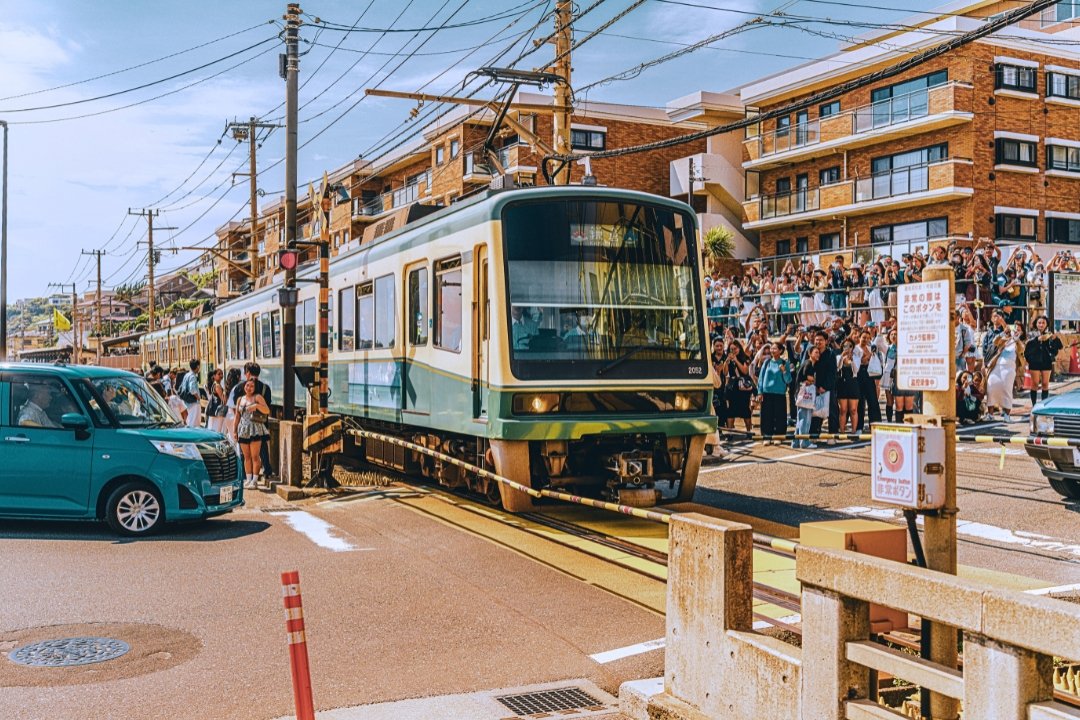

A railway crossing in Kamakura is not, on paper, the sort of place that should attract international tourists. There is no grand architecture, no museum and no spectacular natural landmark. It is a functioning piece of railway infrastructure beside an ordinary road. Yet visitors arrive with cameras and phones because they recognise it from a story they encountered on screen. For them, the attraction is not simply the crossing itself, but the connection between the real landscape and the fictional world they remember.
That distinction is becoming increasingly important to Japan’s tourism and property industries. Across the country, locations associated with anime and manga are acquiring a new kind of commercial value. Railway stations, shopping streets, cafés, hotels and even ordinary neighbourhoods can become destinations when they acquire a place within a popular story. What began as a largely fan-driven practice has developed into a more organised form of tourism, with local authorities, transport operators, retailers, hotels and destination managers increasingly recognising the economic potential of the phenomenon.
The timing could hardly be more significant. Japan received approximately 42.68 million international visitors in 2025, the first year in which annual arrivals passed 40 million, while inbound visitor expenditure reached approximately ¥9.5 trillion, both records. Anime tourism represents only one component of that much larger market, but it behaves differently from conventional sightseeing. Rather than simply directing more visitors towards Tokyo, Kyoto and Osaka, it can give travellers a reason to seek out places that might otherwise never appear on an international itinerary. In doing so, it creates an unusual relationship between intellectual property and physical space.
The phenomenon is often described in Japan as seichi junrei, or anime pilgrimage. The term captures something more substantial than fandom. A conventional tourist visits a landmark because it is historically or culturally important; an anime pilgrim visits because a fictional story has given an existing place personal meaning. The distinction is commercially important. A destination does not necessarily need to construct a new attraction to generate demand. Sometimes the story itself is enough to turn an otherwise ordinary piece of the built environment into a place worth travelling for.

Japan has been aware of this potential for some time. The Anime Tourism Association was established in 2016, the same year that Makoto Shinkai’s Your Name became an international phenomenon. Its annual selection of the ‘88 Anime Pilgrimage Spots’ helped formalise a practice that had already been developing organically among fans. The number is a deliberate reference to the traditional pilgrimage route across Shikoku, but the underlying idea is modern: connect fictional worlds with the physical locations that inspired them and create a reason for visitors to travel through the country.
The timing of Your Name was significant because the film demonstrated how powerful that connection could become. Its detailed depictions of Tokyo and rural Gifu gave audiences recognisable locations to seek out in the real world. The Suga Shrine staircase in Tokyo became particularly associated with the film, while Hida-Furukawa in Gifu gained international attention because of its connection with the story. The Japanese government subsequently identified anime and manga pilgrimage as a potential contributor to local economic revitalisation, recognising that content could draw visitors towards places that conventional tourism promotion had struggled to put on the international map.
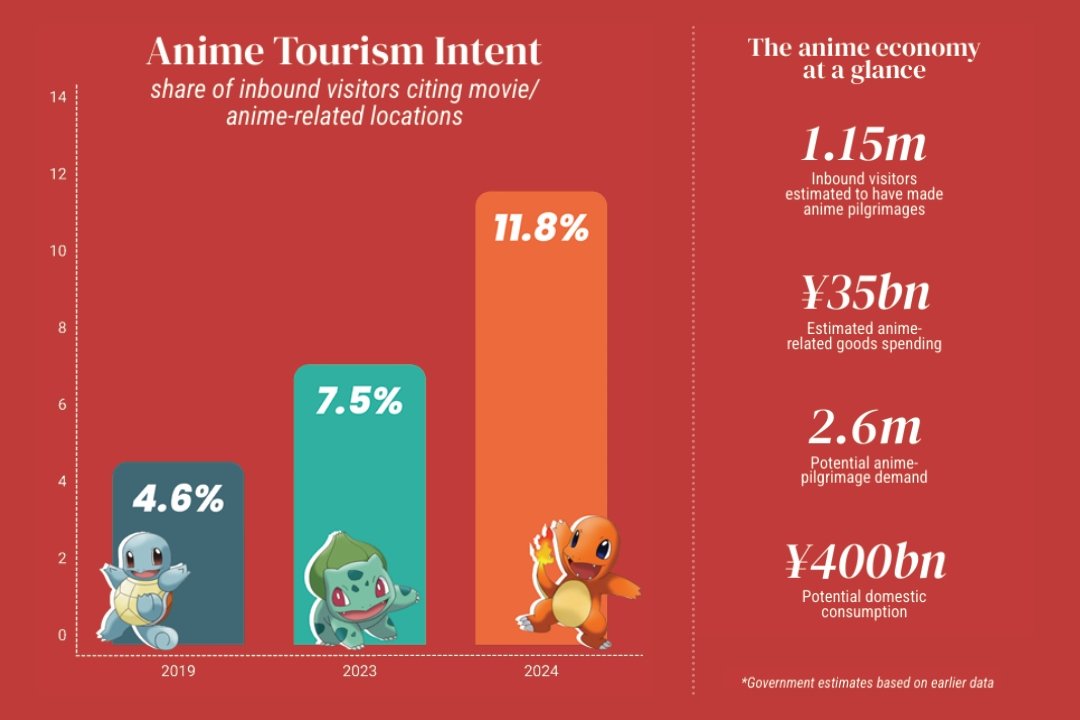
The economic potential was already visible in government analysis before the current tourism boom. A Cabinet Office and Development Bank of Japan study estimated that around 1.15 million inbound visitors made pilgrimages to anime-related sites, with approximately ¥35 billion spent on anime-related goods. It also estimated potential demand of 2.6 million people and ¥400 billion in domestic consumption if the market developed further. Those figures date from the earlier stage of Japan’s anime-tourism economy and should not be mistaken for a measurement of today’s market, but they demonstrate that the economic significance of the phenomenon was being recognised well before Japan’s latest tourism records.
More recent data suggests that interest has continued to develop. A Japan Tourism Agency survey cited by the Japan National Tourism Organization found that approximately 11.8 per cent of visitors to Japan in 2024 mentioned visiting movie- and anime-related sites as a purpose of their next trip to the country. The wording is important: the figure does not mean that 11.8 per cent of visitors travelled primarily because of anime. It indicates that screen-related locations had become a meaningful consideration in future travel planning. JNTO has subsequently positioned anime and manga-inspired travel as one route through which visitors can discover destinations outside Japan’s traditional tourism centres.
The wider anime economy provides an important backdrop. According to JNTO, the Association of Japanese Animations estimated the Japanese anime market at a record level in 2024, with overseas markets accounting for more than half of the total. The international popularity of Japanese animation therefore creates an audience far beyond the country’s borders before any traveller has booked a flight. Tourism is one of the ways in which that cultural influence eventually reaches the physical economy.
Nowhere is the transition from fandom to place-making more apparent than in Kamakura. The railway crossing near Kamakura High School Mae Station on the Enoden line became closely associated with Slam Dunk, one of Japan’s best-known basketball manga and anime franchises. Fans visit not because the crossing has intrinsic architectural importance, but because it allows them to stand inside a recognisable scene. The photograph becomes part of the experience: the visitor is effectively reproducing a frame from the story in the physical world.
The commercial effect extends beyond the photograph. Visitors travelling to an anime location require transport, food and drink, retail and depending on the distance travelled, accommodation. The surrounding businesses therefore become incidental participants in the attraction. A café does not have to own the intellectual property to benefit from it. A railway operator does not have to build a theme park. A small retailer can gain international customers simply because it happens to sit on the route between one location and another.
But Kamakura also demonstrates the other side of the equation. The crossing remains part of a functioning residential and transport environment. The popularity of the location has created concerns around visitors standing in or near the road to take photographs, prompting local authorities to introduce measures aimed at improving safety and managing visitor behaviour. The attraction illustrates a problem that will become increasingly familiar as screen-related tourism expands: the physical environment may become valuable to visitors long before it is equipped to receive them.
For property owners and destination managers, this is an important distinction. The creation of demand does not automatically create capacity. A road remains a road, a railway crossing remains a railway crossing and a residential street remains a residential street, regardless of how many people now recognise it from an animated series. Once an ordinary location becomes a tourism asset, however, pressure begins to fall on the surrounding infrastructure.
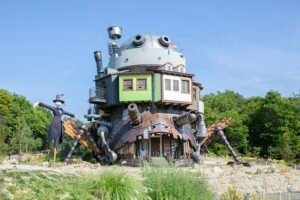
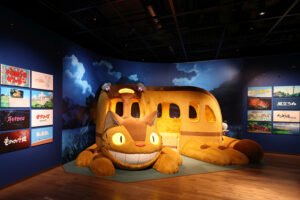
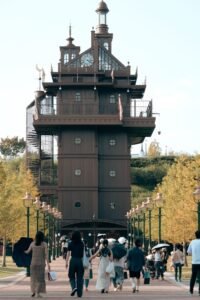
A very different model can be found in Aichi Prefecture, where the physical destination was created around the intellectual property from the beginning. Ghibli Park, which opened in 2022 within the former Expo 2005 Aichi Commemorative Park, translates the worlds of Studio Ghibli into a physical visitor experience. Rather than asking visitors to identify an existing location from a film, the project constructs environments in which the visitor can enter the visual and emotional world of the films themselves.
The scale of the project demonstrates the extent to which Japanese regional authorities are prepared to connect entertainment IP with physical development. Aichi Prefecture invested approximately ¥34 billion in the development, while earlier planning projections envisaged around 1.8 million visitors annually and an economic impact of approximately ¥48 billion a year. Those original figures were forecasts rather than measures of current performance and the economics of the park have evolved since opening. Nevertheless, the project represented a substantial public commitment to turning cultural IP into a regional visitor asset.
The story has since developed further. In March 2026, Aichi Prefecture announced a new estimate putting the annual economic ripple effect from Ghibli Park visitors at approximately ¥71 billion, substantially above the ¥48 billion estimate published during the project’s planning stage. The prefecture attributed much of the increase to higher visitor spending than originally anticipated.
That evolution is particularly relevant to the hospitality industry. A major attraction does not exist in isolation from the hotel market around it. Visitors need somewhere to stay, places to eat, transport between the attraction and city centres, and activities before and after their visit. An attraction can therefore become an anchor around which a wider hospitality economy develops.
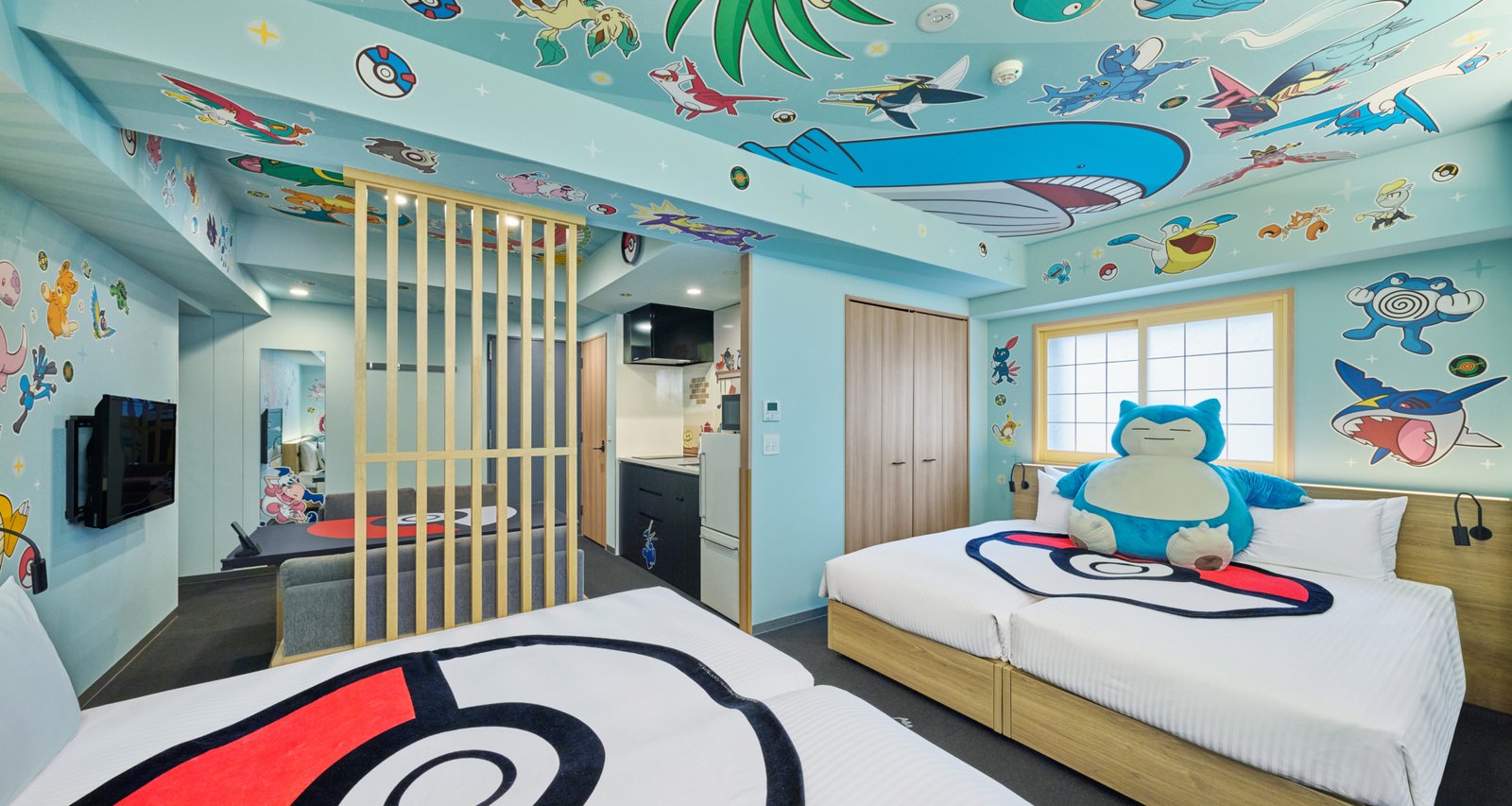
Anime’s influence on accommodation is becoming more direct as well. MIMARU, the Japanese apartment-hotel operator, has developed official Pokémon Rooms in Tokyo, Kyoto and Osaka. The concept goes beyond a few branded accessories. The rooms are designed around the Pokémon universe, with themed bedrooms, kitchens, bathrooms and dining areas, and the current programme has expanded to ten participating properties.
The significance of the Pokémon Rooms is not that hotels have suddenly discovered themed bedrooms. It is that a major hotel operator is treating intellectual property as a specific accommodation proposition. The guest is not merely buying a room in a convenient location; for a particular segment, the room itself becomes part of the destination experience.
This suggests a more sophisticated opportunity for hotel operators. The future of anime-linked accommodation is unlikely to depend on simply covering rooms with characters. The stronger proposition is specificity: an official relationship with an established franchise, a clearly defined audience and an experience that gives the customer a reason to choose one property over another.
Location can be just as powerful as theming. Hotels situated close to established anime districts, conventions, attractions and pilgrimage routes can benefit from their surroundings without carrying the cost or licensing requirements of a fully branded product. In that sense, anime tourism reinforces a familiar principle of hospitality real estate: location remains one of the industry’s most valuable assets, but the reasons a location is valuable can change.
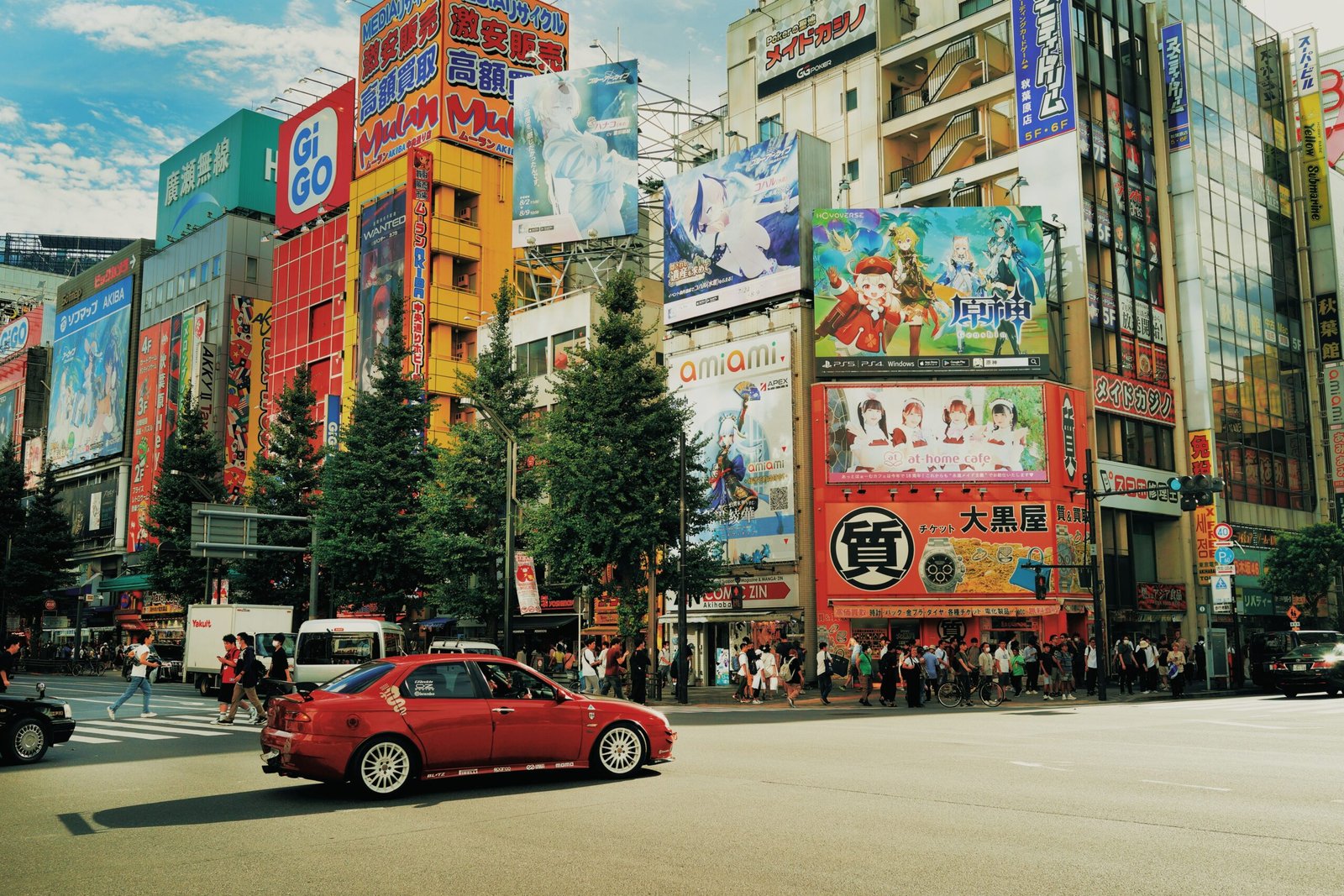
The same process is visible in retail. Akihabara is perhaps the clearest example of a district in which fandom has become part of the identity of the physical environment. The Tokyo neighbourhood has evolved into an international destination for anime, manga, gaming, character merchandise, arcades and themed cafés. Visitors are not simply travelling there to purchase a particular product. They are travelling to experience the district itself.
That distinction matters at a time when physical retail faces intense competition from e-commerce. A product can be purchased online, but a retail district can offer participation, discovery and community. The experience of walking through specialist shops, finding merchandise unavailable elsewhere, visiting a themed café and encountering other fans is itself part of the value proposition.
Anime therefore provides an interesting model for destination retail. The strongest districts are not necessarily those with one successful shop. They are ecosystems in which multiple businesses reinforce one another. Specialist retailers create a reason to visit; cafés encourage visitors to stay longer; arcades and entertainment venues increase dwell time; events generate periodic surges in footfall; hotels capture overnight demand; and transport infrastructure connects the district to the wider city.
For landlords and developers, this creates a different way of thinking about retail value. A successful commercial district is no longer defined solely by the quality of its individual tenants. Its cultural identity can itself become an economic asset.
The rural opportunity may be even more significant.
Japan’s tourism authorities have spent years attempting to spread the benefits of inbound tourism beyond the country’s most visited destinations. Tokyo, Kyoto and Osaka possess powerful global brands and established infrastructure, but the concentration of visitors creates pressure in some locations while leaving other regions comparatively underexposed. Anime can alter that equation because its destinations are determined by stories rather than conventional tourism rankings.
A small town does not need a world-famous temple to appear in an anime. It may simply be the hometown of a creator, the setting chosen for a story or the landscape that a production team considered visually appropriate. Once audiences develop an emotional connection with the setting, however, the town acquires something that conventional tourism infrastructure cannot easily manufacture: a reason to visit.
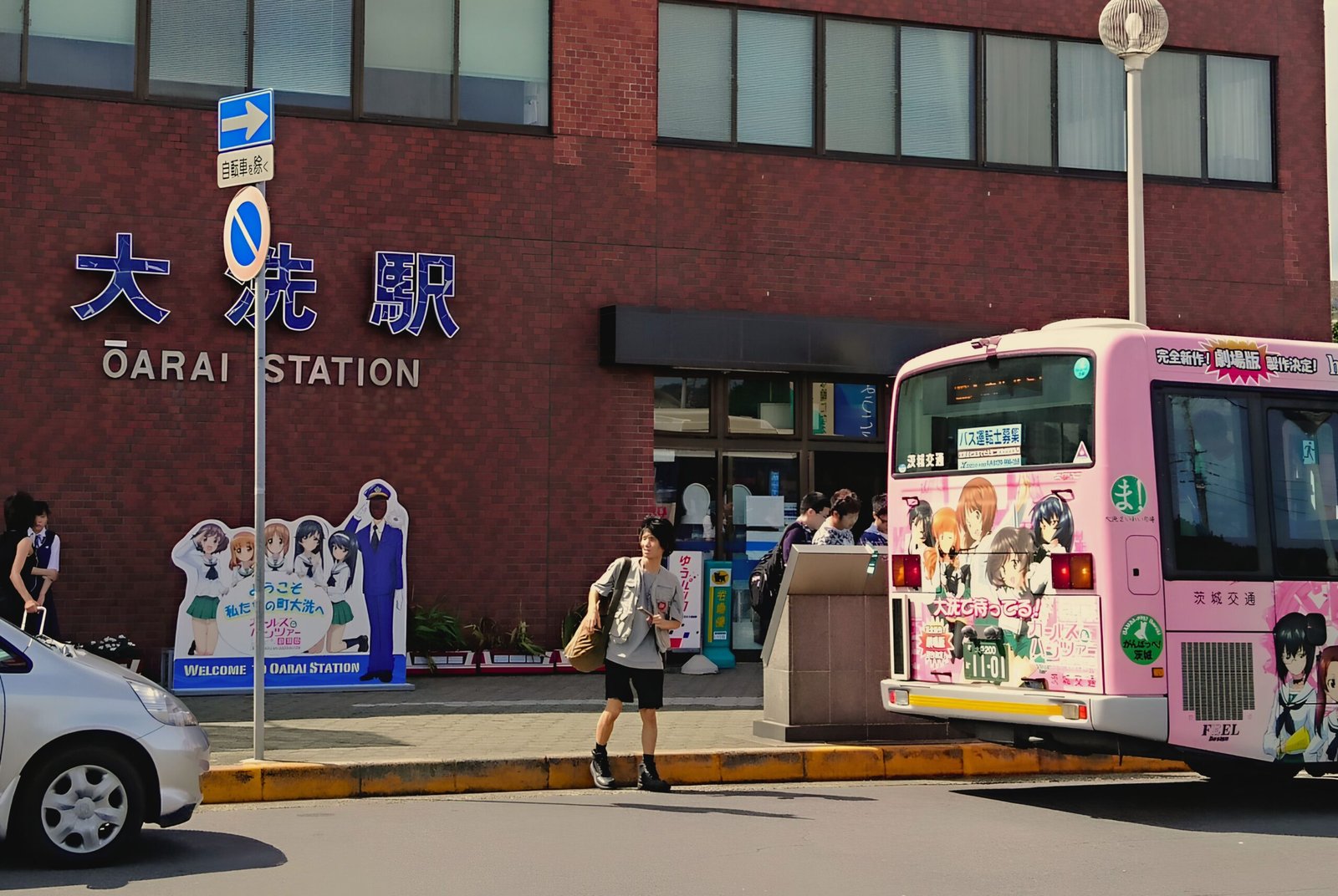
Oarai in Ibaraki Prefecture provides a useful example. The town became closely associated with Girls und Panzer, and local businesses incorporated the series into their shops, events and visitor experiences. Its annual Anglerfish Festival, traditionally a local event, grew from attendance in the tens of thousands to approximately 140,000 in 2019 as anime fans became an important part of the audience.
The significance of Oarai is not simply the number of visitors. It is the way the relationship developed between the fictional property and the existing town. Anime became embedded in the commercial fabric rather than being confined to a single purpose-built attraction. Restaurants, retailers, transport operators and community events all became part of the visitor experience.
That model has implications well beyond anime.
For a regional authority dealing with population decline, ageing communities or underused commercial space, an established intellectual property can provide a form of destination branding with an audience already attached to it. The challenge is then to convert that initial interest into broader local spending and longer stays.
A visitor who arrives to see an anime location may subsequently eat at a local restaurant, stay at a ryokan, purchase regional products, use a local railway and visit nearby cultural attractions. The anime is the initial trigger; the destination economy captures the wider value.
This is also why the relationship between anime and infrastructure deserves greater attention. The economic value of an intangible asset eventually has to be accommodated in physical space. More visitors mean more demand for transport, accommodation, restaurants, shops, public toilets, pedestrian areas, signage, digital connectivity and payment systems. In particularly popular locations, it can mean additional security and crowd-management measures.
Japan’s government is increasingly treating this relationship as part of its wider content strategy. A 2025 government document on intellectual property policy describes a cycle in which local resources are incorporated into content, overseas audiences are attracted to those locations and the resulting tourism creates economic opportunities for the region. It also refers to the potential scale of anime tourism and identifies examples including Ghibli Park and the Attack on Titan-related facilities in Hita
The same policy direction points to a much broader ambition. Japan is seeking to expand the overseas market for its content while using cultural exports to support tourism and regional revitalisation. The strategy treats content not simply as something to sell abroad, but as a mechanism capable of generating demand for Japanese places and experiences.
For real estate investors, that introduces an increasingly relevant question: what happens when cultural relevance becomes part of the value proposition of a location?
Traditionally, property investment has focused on fundamentals such as transport connectivity, employment, population growth, rental demand and surrounding amenities. Those fundamentals remain essential. But in tourism-oriented markets, cultural IP can add another layer. A location associated with a successful franchise may attract visitors who would otherwise never have considered travelling there.
That does not mean investors should begin buying property wherever an anime series is filmed. Popularity can be temporary, licensing relationships can change and audience interest can move rapidly from one franchise to another. The strongest opportunities are likely to be those in which the intellectual property reinforces an already viable destination rather than attempting to create value where none exists.
This is where the difference between Kamakura and Ghibli Park becomes instructive. Kamakura demonstrates what happens when an existing physical environment acquires unexpected demand. Ghibli Park demonstrates what happens when the physical environment is planned around the anticipated power of an established IP. Oarai sits somewhere between the two, showing how a local community can incorporate a fictional property into an existing commercial and cultural landscape.
Each model carries different investment and management implications.
The first requires adaptation. The second requires significant capital and careful capacity planning. The third depends on local participation and the ability to make the connection between the IP and the destination durable enough to survive changes in the popularity of the original work.
There is another lesson emerging from Japan’s experience: anime tourism works best when the visitor is given more than a photograph.
A railway crossing can provide the initial reason to arrive, but it cannot by itself sustain an economy. A hotel needs to provide a reason to stay. A restaurant needs to offer something worth eating. A shopping street needs enough variety to justify the journey. A region needs additional attractions if it wants visitors to remain for more than a few hours.
The most successful destinations therefore turn the emotional connection created by anime into a wider experience. The fictional world opens the door, but the physical destination has to provide the rest.
That may ultimately be the most important development in Japan’s anime tourism economy. The country is moving from a model in which fans simply visit places featured in their favourite works towards one in which content, hospitality, retail, transport and regional development are increasingly connected.
The shift is already visible in the data. Japan’s overall inbound tourism market is at record levels, while JNTO is actively promoting anime and manga-related travel as a means of encouraging visitors to explore locations beyond the country’s established tourist routes. Meanwhile, government policy is placing greater emphasis on the relationship between content exports, tourism and regional economies.
Anime is therefore not replacing temples, hot springs or Japan’s traditional tourism assets. It is doing something different. It is creating new reasons to value places that may have previously been overlooked.
For hotels, that can mean a new customer segment or an experience that differentiates a property. For retailers, it can mean turning a shopping street into a destination rather than simply a collection of shops. For regional authorities, it can offer a route towards dispersing visitors and giving smaller communities a new international identity. For property investors, it raises the possibility that the cultural relevance of a location can become an additional component of its economic value.
The deeper lesson is that tourism is no longer shaped exclusively by monuments and geography. It can also be shaped by stories.
When a fictional world is powerful enough, people will cross borders to find the real places that inspired it. The opportunity for Japan’s hospitality, retail and property industries is to ensure that when those visitors arrive, the physical economy is ready to receive them.