

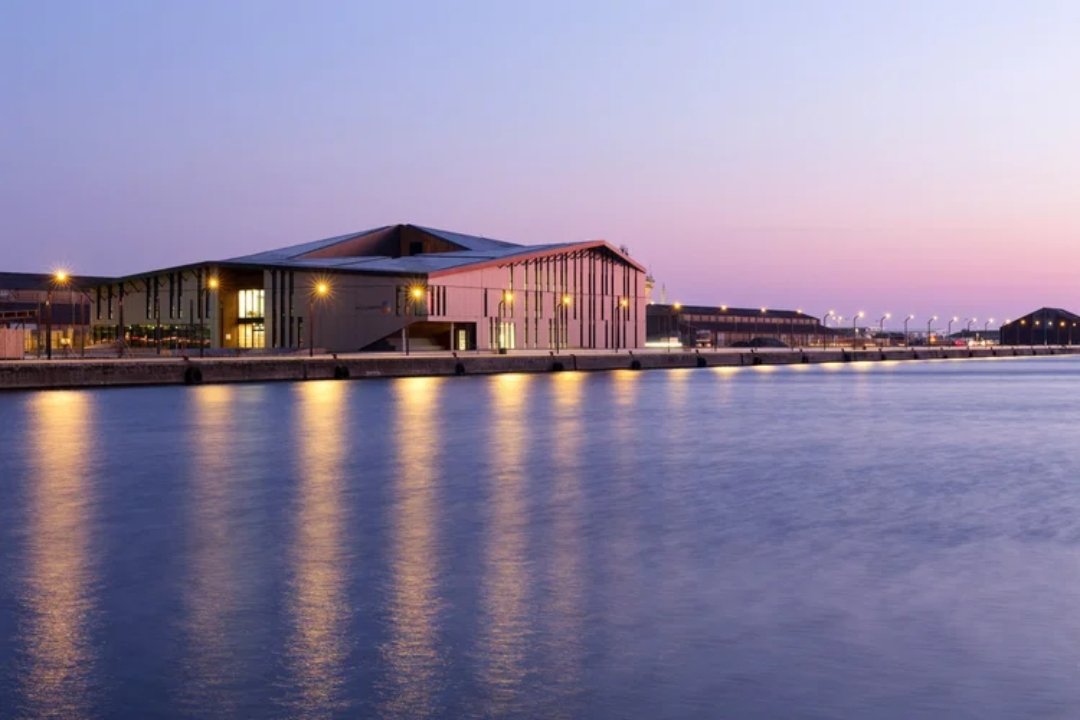

The industrial port of Dunkirk has seen the completion of Écosystème D, a flagship building designed to lead the region toward a cleaner energy future. Located on Mole 2, the structure acts as a catalyst for the energy transition by combining research, training and business incubation under one roof. The project is a central part of the Neptune development strategy which began in the 1990s to reconnect the city centre with former industrial sites.
The facility is an energy positive building that generates more power than its operations require. This is achieved through a bioclimatic design and the installation of 1,200 m² of photovoltaic panels on the roof. Excess energy will be fed into the power loop of the neighbouring innovation park. The design follows the Powerhouse principles which prioritise clean energy production and high quality living environments. Kjetil Trædal Thorsen, Founding Partner and Architect at Snøhetta, noted: “Positive energy buildings are the buildings of the future. The mantra of the design industry should not be ‘form follows function,’ but ‘form follows environment.”
Inside the 50 by 60 metre rectangular structure, the layout centres on a protected patio that provides natural light and ventilation. The building height varies between 9 and 18 metres to accommodate different uses like the large scale prototyping technology hall and various flexible workspaces. A wide staircase connects the different levels and serves as an informal meeting space for users. The architecture uses a solid wood structure and local materials to reach level 3 of the “Bio-Based Building” label with more than 36 kg of bio-based materials per m².
The building avoids active air conditioning by using adiabatic cooling and cross ventilation. Its thermal envelope includes triple glazing and high performance insulation to maintain efficiency. The folded roof design is inspired by traditional port warehouses and helps to optimise solar capture while protecting the interior from prevailing winds.
Multiple partners including the Urban Community of Dunkirk, the Grand Port Maritime and various engineering schools support the activities within the hub. The external forecourt acts as an extension of the showroom and features educational displays about renewable energies. This open design aims to link the local society with the ongoing industrial transformation of the Hauts-de-France region.
![[IRHM] logo](https://irhmagazine.com/wp-content/uploads/2025/08/IRHM-AWARDS-2025-1024x683.jpg)