


Larry Ellison has spent almost five decades building Oracle into one of the world’s most valuable software companies, and much of that wealth has subsequently flowed into an unusually broad real estate portfolio. His property holdings stand apart from the conventional billionaire collection of trophy residences, combining an entire island, operating resorts, undeveloped land and high-value private estates.
From the Bronx to the boardroom
Lawrence Joseph Ellison was born in New York City in August 1944 to a single mother. He was sent to Chicago as an infant after contracting pneumonia and was subsequently adopted and raised by his aunt and uncle, Lillian and Louis Ellison. He attended the University of Illinois and briefly studied at the University of Chicago before leaving university and moving to California, where he worked as a computer programmer.
In 1977, Ellison co-founded Oracle, which grew into one of the world’s largest database and enterprise software companies. He served as chief executive for 37 years before stepping down in 2014, when he became executive chairman and chief technology officer, positions he continues to hold.
His fortune, closely tied to Oracle’s share price, has fluctuated sharply. As of September 2026, Forbes ranked Ellison as the world’s seventh-richest person, with an estimated net worth of US$193 billion.
That wealth has funded a property portfolio spanning Hawaii, California, Florida and Rhode Island, with holdings ranging from resorts and large land parcels to private residences. The full value of the portfolio is difficult to establish because many properties are held through private entities and transaction values are not always disclosed.
Lanai: an island as a business plan
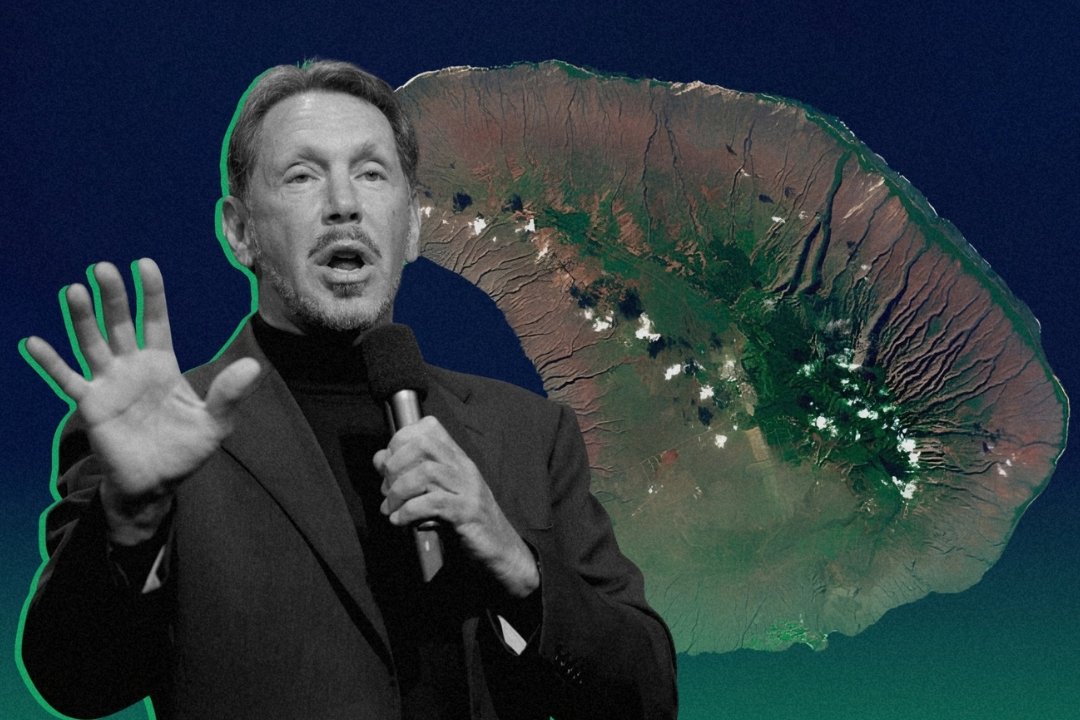
The centrepiece of Ellison’s holdings is Lanai, Hawaii’s sixth-largest island. In 2012, he acquired approximately 98 per cent of the island’s 90,000 acres from Castle & Cooke for a reported US$300 million. The acquisition included the island’s two major resorts at the time, as well as extensive undeveloped land.
Ellison subsequently invested in the island’s tourism, agriculture and infrastructure, while the hospitality operation developed around the Four Seasons Resort Lanai and Sensei Lanai. The result is fundamentally different from owning a single luxury resort: Ellison controls most of the island’s land while also owning major hospitality assets operating within the same destination.
The Lanai acquisition also illustrates the distinctive scale of Ellison’s property strategy. Rather than acquiring one address within an established destination, he acquired control of most of the island’s privately owned land and key tourism assets. That gives him a degree of influence over the island’s development that would be unusual for a conventional private property investor.
A hospitality portfolio, not just a home collection
Ellison’s holdings extend well beyond Lanai and include a significant collection of operating hospitality properties. In August 2024, he acquired the Eau Palm Beach Resort & Spa in Manalapan, Florida, for approximately US$277.4 million. The purchase added another established resort operation to a portfolio that includes the Four Seasons Resort Lanai, Nobu Ryokan Malibu and Sensei Porcupine Creek in California.
Porcupine Creek, a 246-acre former golf estate in Rancho Mirage, California, was acquired by Ellison in 2011 for a reported US$42.9 million and subsequently developed into a private wellness retreat under the Sensei brand. The transformation is significant because it demonstrates another feature of his property strategy: acquiring an existing land asset and repositioning it around a different hospitality proposition.
The pattern is repeated across the portfolio. The assets are not simply valuable properties held for appreciation or personal use. Several are operating businesses in which the underlying land, buildings, hospitality brand and destination proposition are closely connected.
The residential footprint
Alongside the operating assets sits a substantial residential collection. Ellison has accumulated properties in some of the most expensive coastal and residential markets in the United States, including Malibu, Woodside, Newport and Manalapan.
His Malibu holdings include multiple properties along Carbon Beach. In Florida, he acquired a 16-acre oceanfront estate in Manalapan for approximately US$173 million, a transaction that set a Florida residential property record at the time. The estate includes a large residence positioned between the Atlantic Ocean and the Intracoastal Waterway.
The Manalapan purchases form part of a broader concentration of Ellison’s real estate interests in Palm Beach County. His acquisition of Eau Palm Beach added an operating resort to the residential land holdings, creating a combination of private property and commercial hospitality assets within the same local market.
In November 2025, an Ellison family foundation entity also acquired Lion Country Safari, the long-running drive-through safari park in Loxahatchee, Florida. The acquisition broadened the portfolio beyond conventional luxury residential and hotel property into a large-scale visitor attraction and operating tourism asset.
Property as infrastructure
Ellison’s portfolio offers a useful counterpoint to the standard billionaire real estate narrative of isolated mansions bought primarily for privacy and prestige. Its most distinctive assets combine land ownership with operating businesses, hospitality and destination development.
Lanai remains the clearest example. By controlling most of the island’s land alongside major hospitality assets, Ellison has the ability to influence the development of an entire destination rather than simply owning a property within one. His Florida holdings demonstrate a smaller-scale version of the same approach, combining residential land with an operating resort and other tourism assets.
That makes Ellison’s real estate strategy unusual even among ultra-high-net-worth investors. The defining feature is not simply the value of the properties, but the scale and combination of land, hospitality and operational control.
Whether that model is replicable or remains a product of extreme wealth, it provides a revealing case study in how private capital can approach hospitality real estate at a scale more commonly associated with institutional investors and sovereign wealth funds.
“The assets are not simply valuable properties. They combine land ownership with operating businesses, hospitality and destination development.”